[1900–1920]
El primer periódico de Nova Gradiška, Blebetalo (revivido en 1997 y desde entonces publicado regularmente cada año durante las celebraciones de carnaval de la ciudad por la Oficina de Turismo de Nova Gradiška), apareció en Eslavonia en 1900. Su editor fue la Juventud Croata de Nova Gradiška, una asociación de alumnos de secundaria y estudiantes universitarios. El número 4 de este periódico se publicó en 1902, pero se desconoce la duración total de su publicación.
El número cero de Veseli brat (El Hermano Alegre) apareció el 25 de diciembre de 1913. En el subtítulo se definía como “periódico o chisme para instrucción, molestia y masaje social”. Se publicaba en Nochevieja y se distribuía gratuitamente entre los miembros del HPD Graničar y los invitados externos. Contenía interesantes noticias sociales, (des)aventuras políticas y relatos y anécdotas urbanas. El autor de la mayoría de los textos fue el ingeniero Vilko Vidmar, quien también fue el principal impulsor de la impresión del periódico y, además, guardabosques y miembro del consejo del HPD Graničar. La mayor parte de los textos fue censurada, quedando solo los títulos. El periódico fue prácticamente mutilado, ya que debajo de los encabezados aparecían espacios en blanco con anotaciones como: “Confiscado (seguridad, consideraciones preelectorales, sorpresa, consideraciones postelectorales, noticias sociales, etc.)”.
Komarac (El Mosquito) apareció aproximadamente una década más tarde. Se publicaba en ocho páginas de pequeño formato. Todos los contenidos y las ilustraciones estaban escritos a mano y reproducidos mediante papel carbón. Fue creado por estudiantes de secundaria y universitarios de Nova Gradiška. En cuanto a su contenido, abordaba las (des)aventuras políticas actuales, diversos escándalos y deficiencias locales. Se desconoce el número total de ejemplares publicados; solo se conserva el número 3, fechado el 2 de septiembre de 1923.
(Fuente: https://novagra.h)
La revista humorística más longeva de aquel período fue Koprive (Las Ortigas), un periódico de sátira y humor editado por Edo Marković. Se publicó en Zagreb desde el 15 de junio de 1906 hasta el 20 de octubre de 1939. Cada año se publicaban alrededor de cuarenta números, lo que significa que su periodicidad era de aproximadamente diez días. En sus inicios fue un suplemento regular del periódico Pokret, órgano de los progresistas croatas, con una altura de página de 32 cm, impreso en la imprenta de Milivoj Majcen.
Desde comienzos del siglo XX hasta 1914, en Croacia aparecieron varios otros periódicos humorísticos, en su mayoría vinculados al carnaval: Pokladnik streljački (“periódico humorístico para bellas damas, señoritas y caballeros distinguidos”) en Bjelovar; el bimestral Satir de Zagreb; Šraka (hoy Sraka) de Samobor; el semimensual Knut de Srijemska Mitrovica, dirigido por el célebre humorista, aforista y traductor croata Iso Velikanović, que también publicaba caricaturas de dibujantes extranjeros; el bimestral Kerempuh Petrica; el ilustrado periódico carnavalesco Šerlok Holmes de Sisak; y las publicaciones zagrebíes Vušivec y Knjižnica humoristička.
(Fuente: Actas del Congreso Científico y Profesional Internacional 2019, Subotica, 25–26 de octubre de 2019)
“Mientras Koprive era una revista humorística destinada a los sectores más amplios de la sociedad y ya en 1906 había asegurado una sólida posición en el mercado, el quincenal Šišmiš (El Murciélago) fue concebido no solo como competencia de Koprive, sino también con la intención de atraer a un público diferente, como lo demuestra el subtítulo ‘revista artístico-humorística’ que figuró durante un tiempo en su cabecera. Con su gran formato y amplias reproducciones de caricaturas, Šišmiš se acercaba a los modelos alemanes y franceses, orientándose hacia un público más instruido y a estratos sociales más elevados interesados en el arte y familiarizados con las tendencias de la moda. Šišmiš (1915–1917) apareció durante la Primera Guerra Mundial como un entretenimiento destinado a crear una distancia satírica frente a la guerra y a señalar su absurdo.”
(Fuente: artículo especializado de Frane Dulibić, “Šišmiš de Otto Antonini – entre la Secesión y el art déco”, Bosona*, 9 (2019), 14–21; artículo académico no arbitrado)*
“La revista Koprive (1939–1941 bajo el título Nove koprive), quincenal hasta 1913 y posteriormente semanal, surgió en el círculo intelectual que se reunía en el Café del Teatro (Kazališna kavana) de Zagreb. Como la publicación de mayor duración en la historia de la prensa humorística croata, Koprive cambió varias veces de editor (durante más tiempo fue publicada por Jugoštampa d. d.). Excepto en los períodos de mayor control censor (Primera Guerra Mundial, dictadura del rey Alejandro), la revista atacó satíricamente a las más altas autoridades del poder ejecutivo, la política y el clero, y reaccionó ante cuestiones nacionales y sociales no resueltas. Predominantemente llena de un humor sencillo, el llamado humor de chistes, la revista cultivó el reportaje humorístico local, escrito en su mayoría en los dialectos kajkaviano y čakaviano, así como el reportaje humorístico en verso. Un rasgo significativo de la revista fue la caricatura, que, gracias a las contribuciones de un gran número de destacados pintores y grabadores (J. Račić, P. Križanić, Slavko Vereš, F. Angeli-Radovani, Sergej Mironović, A. Motika, I. Režek, entre otros), alcanzó un alto valor artístico. Como editores firmaron la revista S. Vereš, Zvonimir Biljan, K. Kovačić, Slavko Vodvarška, K. Mesarić, entre otros.”
(Fuente: Enciclopedia Croata, edición en línea. Instituto Lexicográfico Miroslav Krleža, 2013–2025. Consultado el 11 de diciembre de 2025.)
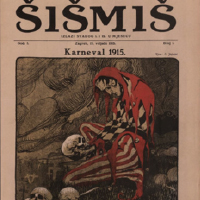
Šišmiš fue fundado en Zagreb por el pintor, ilustrador y pionero del diseño gráfico en Croacia Oto Antonini. Fue impreso y publicado por Vladimir Rožanowski y editado por el periodista y publicista Dinko T. Chudoba. Se publicó como una revista ilustrada con una altura de página de 38 cm, con periodicidad semimensual, desde el 15 de febrero de 1915 hasta el 15 de diciembre de 1917, y también fue conocida como revista artístico-humorística. Las portadas, anuncios e ilustraciones fueron diseñados en estilo secesionista, mérito en gran parte del artísticamente dotado fundador Oto Antonini, quien incluso publicó caricaturas bajo el seudónimo Strihnini.
Entre las publicaciones menos conocidas cabe mencionar el periódico humorístico Praporac de Delnice, publicado por cuenta propia en 1908, cuyo editor y responsable fue I. Škorić. Se publicó únicamente uno (o quizá dos) números en la imprenta de S. Jünker en Sisak, con una altura de página de 25 cm.
También pasó casi inadvertido Jovo Tražiga, como suplemento de la revista de literatura, ciencia, arte y crítica Hrvatska smotra. Se publicaba de forma semimensual en la Imprenta por Acciones de Zagreb, en páginas de formato 28 cm. En 1910 se publicaron solo siete números, y su editor fue el escritor Zvonimir Vukelić. El periódico Nos (La Nariz, 1917–1939), editado por el escritor Zvonimir Vukelić Zyra, apareció de forma irregular en páginas de formato 21 cm. Vladimir Horvat editó el periódico de entretenimiento y humor Karlovački ričet, publicado cerca de Zagreb.
En la próxima entrega nos ocuparemos del gran número de periódicos humorísticos y satíricos que se publicaron en el sur de Croacia, en Split y sus alrededores, donde el más conocido de ellos, el dalmata Duje Balavac, fue el equivalente sureño de Koprive de la Croacia central.
(This text has been translated into Spanish by Chat GPT)

(Novogradiško) Blebetalo (reizdanje 2014.)

Koprive

Šišmiš

Šišmiš (iznutra)
Fuente de las cubiertas: Registros bibliográficos del Catálogo de la Biblioteca Municipal de Zagreb (material digital)
Source of covers: Bibliographic records of the Zagreb City Library Catalogue (digital material)
CROATIAN HUMOR MAGAZINES (Part 2)
By Dražen Jergović
[1900–1920]
The first newspaper from Nova Gradiška, Blebetalo (revived in 1997 and since then published regularly every year during the city’s carnival celebrations by the Nova Gradiška Tourist Board), appeared in Slavonia in 1900. Its publisher was the Nova Gradiška Croatian Youth, an association of secondary-school pupils and university students. Issue No. 4 of this paper was published in 1902, but the total duration of its publication is unknown.
The zero issue of Veseli brat (The Merry Brother) appeared on December 25, 1913. Its subtitle read “a paper or gossip for instruction, annoyance, and social massage.” It was published on New Year’s Eve and distributed free of charge to members of the HPD Graničar and outside guests. It contained interesting social news, political (mis)fortunes, and urban anecdotes and short stories. The author of most of the texts was engineer Vilko Vidmar, who was also the main initiator of the paper’s publication and a forestry officer and board member of HPD Graničar. Most of the texts were censored, leaving only the headlines. The paper was effectively mutilated, as beneath the headlines there were blank spaces with notes such as: “Confiscated (security, pre-election considerations, surprise, post-election considerations, social news, etc.).”
Komarac (The Mosquito) appeared about a decade later. It was published on eight small-format pages. All content and illustrations were handwritten and duplicated using carbon paper. It was created by grammar-school pupils and students from Nova Gradiška. Its content focused on current political (mis)fortunes, various scandals, and domestic shortcomings. The total number of published issues is unknown; only issue No. 3, dated September 2, 1923, has been preserved.
(Source: https://novagra.hr)
The longest-running humor magazine of that period was Koprive (The Nettles) – a paper for satire and humor edited by Edo Marković. It was published in Zagreb from June 15, 1906, to October 20, 1939. Approximately forty issues were published each year, meaning it appeared roughly every ten days. Initially, it was a regular supplement to the newspaper Pokret, the mouthpiece of Croatian Progressives, with a page height of 32 cm, printed at the Milivoj Majcen printing house.
From the very beginning of the 20th century until 1914, several other humorous, mostly carnival-related publications appeared in Croatia: Pokladnik streljački (“a humorous paper for beautiful ladies, young ladies, and refined gentlemen”) in Bjelovar; the bimonthly Satir from Zagreb; Šraka (today Sraka) from Samobor; the semi-monthly Knut from Srijemska Mitrovica, edited by the renowned Croatian humorist, aphorist, and translator Iso Velikanović, who also published caricatures by foreign cartoonists; the bimonthly Kerempuh Petrica; the illustrated carnival paper Šerlok Holmes from Sisak; and the Zagreb publications Vušivec and Knjižnica humoristička.
(Source: Proceedings of the International Scientific and Professional Conference 2019, Subotica, October 25–26, 2019)
“While Koprive was a humor magazine intended for the broadest strata of society and secured a firm place on the market as early as 1906, the biweekly Šišmiš (The Bat) was conceived not only as competition for Koprive, but also with the intention of attracting a different audience, as evidenced by the subtitle ‘artistic-humorous paper’ that it bore in its masthead for a time. With its large format and large reproductions of caricatures, Šišmiš was close to German and French models, oriented toward a more educated audience and higher social strata interested in art and familiar with contemporary fashion trends. Šišmiš (1915–1917) appeared during the First World War as entertainment intended to create a satirical distance from the war and to point out its absurdity.”
(Source: professional article by Frane Dulibić, “Šišmiš of Otto Antonini – Between Secession and Art Deco,” Bosona*, 9 (2019), 14–21; non-refereed scholarly article)*
“The magazine Koprive (1939–1941 under the title Nove koprive), a biweekly until 1913 and thereafter a weekly, was launched within the intellectual circle that gathered at the Kazališna kavana (Theatre Café) in Zagreb. As the longest-running publication in the history of Croatian humorous periodicals, Koprive changed several publishers (it was published the longest by Jugoštampa Inc.). Except during periods of intensified censorship (World War I, the dictatorship of King Alexander), the magazine satirically attacked the highest authorities of executive power, politics, and the clergy, and responded to unresolved national and social issues. Predominantly filled with unpretentious so-called joke humor, the magazine cultivated local humorous reporting, mostly written in the Kajkavian and Chakavian dialects, as well as humorous verse reporting. A significant feature of the magazine was caricature, which, through the contributions of a large number of prominent painters and graphic artists (J. Račić, P. Križanić, Slavko Vereš, F. Angeli-Radovani, Sergej Mironović, A. Motika, I. Režek, among others), reached a high level of artistic value. The magazine was edited at various times by S. Vereš, Zvonimir Biljan, K. Kovačić, Slavko Vodvarška, K. Mesarić, and others.”
(Source: Croatian Encyclopedia, online edition. Miroslav Krleža Lexicographical Institute, 2013–2025. Accessed December 11, 2025.)
Šišmiš was founded in Zagreb by painter, illustrator, and pioneer of graphic design in Croatia, Oto Antonini. It was printed and published by Vladimir Rožanowski and edited by journalist and publicist Dinko T. Chudoba. It appeared as an illustrated magazine with a page height of 38 cm, published semi-monthly from February 15, 1915, to December 15, 1917, and was also known as an artistic-humorous paper. Covers, advertisements, and illustrations were designed in the Secession style, largely thanks to the artistically gifted founder Oto Antonini, who even published caricatures under the pseudonym Strihnini.
Among the lesser-known publications, mention should be made of the humorous paper Praporac from Delnice, published at the editor’s own expense in 1908, with I. Škorić as publisher and editor. Only one (or possibly two) issues were published at the S. Jünker printing house in Sisak, with a page height of 25 cm.
The supplement Jovo Tražiga, attached to the journal for literature, science, art, and criticism Hrvatska smotra, also passed largely unnoticed. It was published semi-monthly at the Joint-Stock Printing House in Zagreb on pages measuring 28 cm. Only seven issues were published in 1910, and it was edited by writer Zvonimir Vukelić. The paper Nos (The Nose, 1917–1939), edited by writer Zvonimir Vukelić Zyra, was published irregularly on pages measuring 21 cm. Vladimir Horvat edited the entertainment-humor paper Karlovački ričet, published near Zagreb.
In the next installment, we will turn our attention to the large number of humorous and satirical papers published in southern Croatia, in Split and its surroundings, where the most famous among them, the Dalmatian Duje Balavac, was the southern counterpart to Koprive from central Croatia.
(This text has been translated into English by ChatGPT)