[1939‑1959]
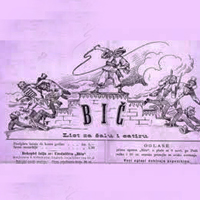
En Croacia, inmediatamente antes, durante y algunos años después de la Segunda Guerra Mundial se publicaron revistas de humor y sátira. La primera de ellas fue Nove koprive, periódico de sátira y humor que salió de noviembre de 1939 a 1941. Se publicaba los miércoles, editada por Jugoslavenska štampa de Zagreb. El redactor responsable fue Imbro Gere. Se conocen en total 38 números publicados, en el formato habitual de la época y con 31 cm de alto. Era la continuación de las mucho más populares Koprive, que se publicaron de 1906 a 1939 y de las que ya se habló anteriormente. Tras una breve pausa debida a los acontecimientos bélicos, en agosto de 1941 se lanzó el semanal humorístico y de entretenimiento croata Bič. Lo fundaron los hermanos Valić. Ya al año siguiente el periódico cambió su nombre por Šilo. Como editor figura primero la Imprenta Estatal Croata, y más tarde la Editorial Ustaša. Tras varios cambios de redacción, el último número de Šilo apareció hacia el final de la Segunda Guerra Mundial, en abril de 1945.
Más o menos al mismo tiempo se pusieron en marcha en Zagreb otras dos revistas. La primera fue Satyricusova humoristička knjižnica, que salió como bimestral de 1943 a 1944 y más tarde como semanal bajo el título Satyricus. Se imprimía en la imprenta de Milan Šufflay y llegó a publicar un total de 43 fascículos. La revista estaba profusamente ilustrada y se imprimía en un formato más pequeño, de 23 cm de alto. La fundó, editó y en ella colaboró con sus textos Milivoj Kern Mačković. Entre 1942 y 1945 también dirigió la revista humorística Šilo y era conocido por su comicidad, sus diálogos vivos y con remates eficaces, sus paráfrasis y temas que describían de forma realista fenómenos sociales, científicos, técnicos y culturales, así como las debilidades humanas en general. Muchos creían que detrás de los textos más mordaces se escondía él mismo bajo el seudónimo de Satyricus. Desde 1952 trabajó como editor en la empresa Narodni list, donde puso en marcha la publicación «Humoreska». La segunda revista se llamaba Vrabac. La lanzó la editorial Novinarska naklada, propiedad de la Asociación Croata de Periodistas, como semanal en junio de 1943. El primer año apareció en formato pequeño y luego pasó al gran formato periodístico, que mantuvo hasta el final de su publicación en la primavera de 1945. Su redactor fue Josip Blažina Jožčenko. Más tarde se publicó con periodicidad quincenal bajo el sello de la Imprenta Estatal Croata de Zagreb. Era una revista ilustrada, de 32 cm de alto, compuesta de cuentecillos humorísticos, sátira política, humorescas, anécdotas y poemas festivos. Los semanarios humorísticos Vrabac y Šilo, que salieron en los tiempos del Estado Independiente de Croacia (NDH), a menudo reproducían noticias de los aliados alemanes e italianos, ofreciendo a veces una imagen distorsionada de los acontecimientos bélicos que tomaban de sus publicaciones, mientras que la sátira más acerada se dirigía contra los Estados enemigos: Gran Bretaña, Estados Unidos y la Unión Soviética, presentando de esos países noticias políticamente oportunas.
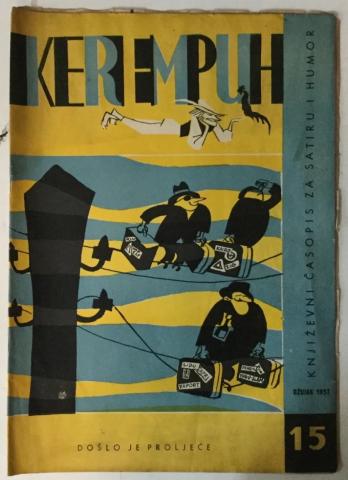
Kerempuh es la más conocida y sin duda una de las revistas humorístico‑satíricas croatas de vida más larga. «Se publicó de 1945 a 2002 en el “Olikprop” de Zagreb, organización de propaganda gráfica del FNL. En el primer número no figuraba el nombre del redactor jefe. A partir del segundo número el redactor jefe fue Ivan Laća, y desde el séptimo número el redactor responsable del periódico fue Veljko Klašterka. Posteriormente la dirigieron también Fadil Hadžić (en varias ocasiones), Milivoj Matošec, Hrvoje Hitrec, Franjo Barbieri, Branka Hlevnjak, Mirko Trišler, Otto Antun Reisinger y otros», en su mayoría caricaturistas conocidos. El primer número apareció el 16 de septiembre de 1945 y el último en julio/agosto de 2002. La revista se imprimía en 8 páginas en formato periódico, con papel de 46 cm de alto, ricamente ilustrada y se publicó la mayor parte del tiempo como quincenal. En su época de mayor popularidad tuvo una tirada media de unas 170 000 copias, lo cual era realmente impresionante para una revista humorística. De octubre de 1955 a noviembre de 1956 salió mensualmente como Revista literaria de sátira y humor. Hasta 1958 volvió a publicarse como periódico semanal independiente, y siguió luego como suplemento del número dominical de Vjesnik hasta finales de 1965. No se publicó entre 1959‑1973 ni entre 1977‑2001. Su editor fue, a partir del número 86 (1947), el Consejo de Redacción de Kerempuh; desde el número 340 (1952), Vjesnik; y desde 1974, la Sociedad de Humoristas Croatas y, desde 2002, la Editorial Humorística. A lo largo de su historia la revista cambió varias veces de formato.
(Fuente de la cita: «Hrvatski biografski leksikon (1983‑2021)», LZMK, Zagreb, 2002, autora del artículo: Klara Pranjko.)
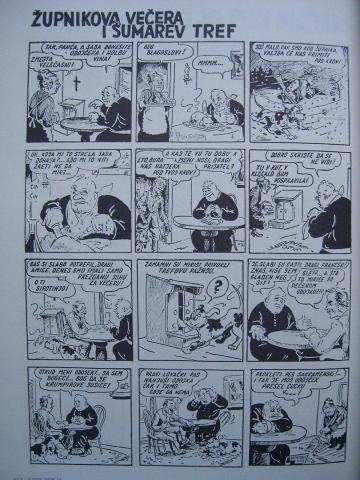
«Ninguna de las revistas mencionadas se acercó en calidad a las antiguas Koprive, sobre todo en lo que respecta al valor de sus caricaturas. Buena parte de las ilustraciones las tomaban de revistas humorísticas alemanas e italianas, ya que no lograron retener por mucho tiempo a los caricaturistas renombrados de la época (Ivo Režek, Franjo Maixner, Walter Neugebauer). Los dibujantes, de nivel más bien amateur, producían sobre todo los llamados chistes ilustrados, sin una verdadera unidad orgánica entre el dibujo y el chiste textual.» La modestia de los trabajos implicaba una lectura y rentabilidad dudosas para las revistas. Con un enfoque tacaño se limitaba el desarrollo de una historieta de calidad. En esa época el cómic se estaba volviendo cada vez más popular. La mayoría de los cómics estaban destinados al público infantil, mientras los adultos “devoraban” el llamado humor “puro”. «Eso significó una adhesión a la propaganda política, dominando las burlas a Churchill, Roosevelt y Stalin, y se fomentaba cada vez más el odio fascista hacia los judíos.» Las historietas satíricas «Hijacint i Narcisa» de Mihael Antol o «Lijek», también conocida como «Dane i Mane na vašaru», de Fadil Hadžić Hafa, publicadas en Vrabac, eran leídas con enorme gusto, ya que aparecían por entregas. Así, poco a poco, los cómics humorísticos de la vida burguesa y pequeño‑burguesa se fueron introduciendo en las revistas de humor y se convirtieron en parte integrante de ellas, adorada por los lectores, lo que contribuyó a una mejor venta y a mayores tiradas. Dibujantes con más talento, como Hadžić, Toma Božić (Albert Kinert) o Willy Landig, colaborando de este modo con la prensa humorística, pudieron resolver en cierta medida y con rapidez sus problemas de subsistencia durante sus años de estudiantes, ganando con sus honorarios para cubrir las necesidades básicas: comida, alquiler de habitaciones, etc.
(Fuente de la cita: Rudi Aljinović, «6. broj Strip revije», Zagreb, abril de 2011.)
Croatian Humor Magazines (Part 4)
by Dražen Jergović
[1939–1959]
In Croatia, humor and satire magazines were published shortly before, during, and for several years after the Second World War. The first of these was Nove koprive, a paper for satire and humor that ran from November 1939 to 1941. It was published on Wednesdays by Jugoslavenska štampa in Zagreb. The responsible editor was Imbro Gere. A total of 38 issues are known, in the usual format of the time, 31 cm high. It was the continuation of the much more popular Koprive, which had been published from 1906 to 1939 and have already been discussed earlier. After a short break due to the war, a Croatian humorous and entertainment weekly called Bič (“Whip”) was launched in August 1941. It was founded by the Valić brothers. As early as the following year the paper changed its name to Šilo (“Awl”). Its publisher was first listed as the Croatian State Printing Institute, later as the Ustaša Publishing Institute. After several changes of editor, the last issue of Šilo appeared near the end of the Second World War, in April 1945.
Around the same time two other magazines were started in Zagreb. The first of these was Satyricusova humoristička knjižnica (“Satyricus’s Humorous Library”), which appeared as a bimonthly from 1943 to 1944 and later as a weekly under the title Satyricus. It was printed in the Milan Šufflay printing house, and a total of 43 booklets were published. The magazine was richly illustrated and printed in a smaller format, 23 cm high. It was founded, edited, and supplied with texts by Milivoj Kern Mačković. Between 1942 and 1945 he also edited the humor magazine Šilo and was known for his comic sense, lively dialogues with effective punch lines, paraphrases, and themes that realistically depicted social, scientific, technical, and cultural phenomena as well as human weaknesses in general. Many believed that he himself, under the pseudonym Satyricus, was the author hiding behind the sharpest texts. From 1952 he worked as an editor at the company Narodni list, where he launched the publication “Humoreska”.
The second magazine was called Vrabac (“Sparrow”). It was launched by the publishing house Novinarska naklada, owned by the Croatian Journalists’ Association, as a weekly in June 1943. In its first year it appeared in a small format, then switched to a large newspaper format, which it kept until it ceased publication in the spring of 1945. Its editor was Josip Blažina Jožčenko. A little later it was issued every two weeks by the Croatian State Printing Institute in Zagreb. It was illustrated, 32 cm high, and consisted of light humorous pieces, political satire, humorous sketches, anecdotes, and comic poems. The humorous weeklies Vrabac and Šilo, which were published in the time of the Independent State of Croatia (NDH), often carried reports from their German and Italian allies, sometimes giving a distorted picture of events at the front taken from those countries’ publications, while their sharp satire was aimed at enemy states—Great Britain, the United States, and the Soviet Union—presenting politically opportune news about them.
Kerempuh is the best‑known and certainly one of the longest‑running Croatian humor‑satire magazines. “It was published from 1945 to 2002 within Zagreb’s ‘Olikprop’—the visual propaganda organization of the People’s Front of Croatia. In the first issue the name of the editor‑in‑chief was not given. From the second issue the editor‑in‑chief was Ivan Laća, and from the seventh issue the responsible editor was Veljko Klašterka. Later it was edited as well by Fadil Hadžić (on several occasions), Milivoj Matošec, Hrvoje Hitrec, Franjo Barbieri, Branka Hlevnjak, Mirko Trišler, Otto Antun Reisinger and others,” all of them mainly well‑known cartoonists. The first issue appeared on 16 September 1945 and the last in July/August 2002. The magazine was printed on eight pages in newspaper format, on sheets 46 cm high, richly illustrated, and mostly came out as a fortnightly. At the height of its popularity it had an average print run of around 170,000 copies, which was truly impressive for a humor magazine. From October 1955 to November 1956 it was published monthly as a Literary Magazine for Satire and Humor. Up to 1958 it again appeared as an independent weekly paper, and then continued as a supplement to the Sunday edition of Vjesnik until the end of 1965. It was not published in the periods 1959–1973 and 1977–2001. From issue 86 (1947) its publisher was the Kerempuh Editorial Board; from issue 340 (1952), Vjesnik; and from 1974, the Croatian Humorists’ Society and, from 2002, Humoristička naklada. The format of the paper changed several times over the years.
(Source of the quotation: “Hrvatski biografski leksikon (1983–2021)”, LZMK, Zagreb, 2002, article author: Klara Pranjko.)
“None of the magazines mentioned matched the former Koprive in quality, least of all in the value of their cartoons. A good part of the graphic material was taken mainly from German and Italian humor magazines, because the editors were unable to retain for long the renowned cartoonists of the time (Ivo Režek, Franjo Maixner, Walter Neugebauer). The artists, working at an amateur level, produced mostly so‑called illustrated jokes, lacking an organic unity between drawing and punch line.” The modest quality of the work meant doubtful readership and profitability for the magazines. A frugal approach limited the development of high‑quality comics. At that time comics were becoming ever more popular. Most comic strips were aimed at children, while adults “devoured” so‑called “pure” humor. “This meant a bow to political propaganda, in which mockery of Churchill, Roosevelt, and Stalin predominated, and fascist hatred of Jews was increasingly encouraged.” The satirical strips “Hijacint i Narcisa” by Mihael Antol and “Lijek”, also called “Dane i Mane na vašaru”, by Fadil Hadžić Hafa, published in Vrabac, were extremely popular with readers because they appeared in serial form. In this way comic strips about bourgeois and petty‑bourgeois life gradually found their way into humor magazines and became an integral part of them, beloved by readers and contributing to better sales and higher print runs. Talented artists such as Hadžić, Toma Božić (Albert Kinert) or Willy Landig, by collaborating with humor papers in this way, were able to solve their financial problems at least partly and quickly during their student days, earning fees that covered their basic needs—food, rent and the like.
(Source of the quotation: Rudi Aljinović, “6th issue of Strip revija”, Zagreb, April 2011.)
(This text has been translated into English by ChatGPT)