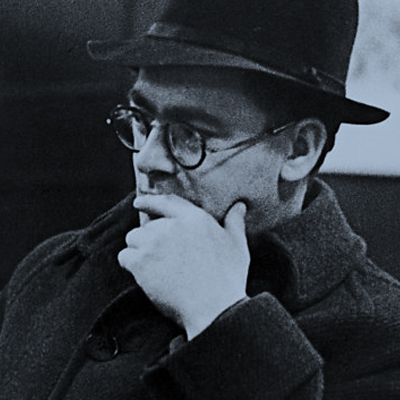
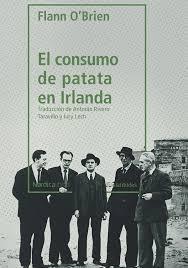
Flann O'Brien (1911-1966), uno de los seudónimos de Brian O'Nolan, es uno de los escritores más importantes de Irlanda, hermanado con James Joyce y Samuel Beckett. Entre los seguidores de Flann está el propio Joyce, Jorge Luis Borges, Anthony Burgess, Dylan Thomas, Graham Green y otros.
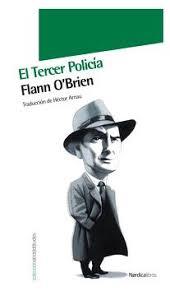
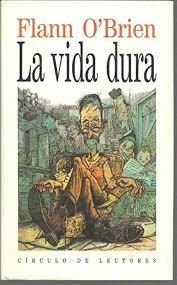
Para los contemporáneos de Flann una parte importante de su obra era el humor. Y sigue funcionando así: puede ser una sonrisa extraída del sin sentido, como un escritor satírico. Así sucede en el texto La vida dura donde las disquisiciones escolásticas o las críticas a los funcionarios públicos o la burla de los formalismos académicos son un claro ejemplo. Ese humor también aparece por contraste: en El tercer policía, en ojos del autor llegamos a un portal y a través de una pequeña ventana (como la pequeña puerta de Alicia), pasamos de un terrible asesinato a un mundo onírico donde los personajes inician una espiral al desatino. Estamos entre Lewis Carroll y Pirandello, donde el juego de palabras y lo absurdo de la situación hacen risible el desarrollo de la trama. Incluso para los personajes hay una parte de esa realidad que no es comprensible: les asusta o les sorprende. Y el lector sonríe, ante esos inútiles intentos cognoscitivos, donde pronto se ve que el esfuerzo mismo es inútil ante la falta de referencias con la propia percepción de lo cotidiano, de lo “normal”. Y vivir en la irrealidad sólo puede llevar al desamparo o a la inercia, como sucede al asesino de El tercer, quien se pierde en las divagaciones, a veces sublimes, del par de policías que nos recuerdan a los hermanos gordos del Alicia de Carroll. La escenografía del mundo se convierte en una fantasía contada entre silenciosas sonrisas. Y como las tramoyas se moldean a capricho, las leyes del mundo que habita el asesino del viejo Mathers se trastocan al grado que incluso la materia se mezcla con los objetos con los que tiene contacto: así, los usuarios de bicicletas terminan por asimilárseles y pierden su humanidad en beneficio de la bicicleta; o los inmuebles cambian de dimensiones y dejan de ser habitables. ¿En qué momento lo improbable se hace imposible y el mero atisbo de su existencia nos sugiere que detrás de lo inasible está lo maligno? En un viaje onírico que bien puede ser la antesala de la muerte, establecemos que ese personaje que contempla lo terrible con envoltura de broma viaja guiado por un Virgilio con disfraz de sombrerero loco que ha leído El Aleph de Borges y nos plantea enigmas físicos para establecer que a todo fenómeno tangible hay una implicación filosófica cuya sola representación mental tiene consecuencias en nuestra persona y nuestro entorno: un juego de cajas llegan al extremo de contener cajas invisibles e intocables por pequeñas, pero que deben estar ahí: un dardo tiene tan delgada la punta, casi a nivel de unos pocos átomos, que es invisible, pero hiere. Los personajes habitan un lugar donde “puede decirse cualquier cosa y será cierta y habrá que creérsela”. Incluso la vista de ciertos colores puede llevar a la locura. Pero el humor de lo absurdo puede llevar un tono sutil: en La vida dura radica en la mera posibilidad (ahí cumplida) de que el truhán que engaña con cursos por correspondencia logre tener una audiencia privada con el Papa para que su tutor hable sobre las “comodidades” femeninas (para hacer sus necesidades).
Uno de los logros de O’Brien en El tercer es esconder el humor en una trama con asesinato al inicio y al final. Cuando el viejo es golpeado, el personaje central supone que sus últimas palabras sonaron como a “no me importa el apio”.
Parte de ese humor deviene de la invención del filósofo inexistente, De Selby, quien lo mismo habla de arquitectura que de filosofía o de átomos o afirma que la tierra tiene forma de salchicha. El lector termina por percibir la broma consistente en hacernos creer que esas divagaciones a veces disparatadas han sido la aportación a la historia de un hombre en apariencia muy importante para la ciencia y quien lo mismo es capaz de romper la continuidad temporal, que hacer whisky en una semana.
El personaje de El tercer dialoga con su voz interior (“Joe”) y por consejo de ésta, le aclara que no puede ahorcarlo sólo por estar en la comisaría cuando se requería un culpable para un crimen irresoluto, pero, sobre todo, porque si va de incógnito y no tiene nombre, prácticamente no está ahí. El policía revira diciendo que si no está ahí no será un ahorcamiento, cuando mucho “una insalubre abstracción… un ejemplo de nulidad negativa neutralizada ya vaciada por asfixia”. Además, la plática con Joe logra la consistencia corpórea del personaje. El manejo de esa voz de conciencia puede darse entre los personajes, como los hermanos de La vida dura, donde el mayor es capaz de inventar desde un manual para caminar sobre alambres, hasta una Universidad de la que brotan libros para enseñar los más dispares oficios, y el hermano es quien lo confronta, sabedor del timo.
El humor de O’Brien no aparece sólo en la trama, sino también en el manejo del lenguaje. En La vida dura, los personajes tienen nombres tal vez burdos, pero sin duda divertidos, por afinidad fonética: el cura se llama Fahrt (flatulencia), el bebedor es Collopy (bocadillo), el amigo Crotty (entrepierna), Cruppy (nalgas), Finbarr (excelente bar), y otros. Esa agilidad creativa lo catapultó a la fama con En Nadar-dos-pájaros, prodigiosa obra donde la narración es interrumpida reiteradamente para mostrar los apuntes del autor sobre temas, palabras e incluso opiniones de los personajes; con ello logra un efecto que ahora nos suena cinematográfico, cuando los actores le hablan a la cámara para involucrar al espectador en una suerte de interlocutor mudo que escucha la versión más íntima del personaje sobre lo que está pasando, generalmente para añadir información conceptual no perceptible a primera vista.
El humor delirante e “irlandés” de Flann funciona por desatar en cualquier latitud los mecanismos básicos del preconsciente y del onirismo verbalizado. Ahí nadie se salva de la broma.
Flann O'Brien, posthumous Fame
By Ricardo Guzmán Wolffer
Flann O’Brien (1911–1966), one of the pseudonyms of Brian O’Nolan, is one of Ireland’s most important writers, akin to James Joyce and Samuel Beckett. Among Flann’s admirers were Joyce himself, Jorge Luis Borges, Anthony Burgess, Dylan Thomas, Graham Greene, and others.
For Flann’s contemporaries, humor was a significant part of his work. And it continues to function that way: it may take the form of a smile drawn from nonsense, like that of a satirical writer. This is evident in The Hard Life, where scholastic disquisitions, criticisms of public officials, and mockery of academic formalism provide clear examples. This humor also appears through contrast: in The Third Policeman, from the author’s perspective, we arrive at a portal and, through a small window (like the little door in Alice), pass from a terrible murder into a dreamlike world where the characters begin a spiral into absurdity. We find ourselves somewhere between Lewis Carroll and Luigi Pirandello, where wordplay and the absurdity of the situation make the unfolding of the plot laughable.
Even for the characters, part of that reality is incomprehensible: it frightens or surprises them. And the reader smiles at those futile cognitive attempts, where it soon becomes clear that the effort itself is useless in the absence of references tied to everyday perception, to what is “normal.” Living in unreality can only lead to helplessness or inertia, as happens to the murderer in The Third Policeman, who loses himself in the digressions—sometimes sublime—of the pair of policemen who recall the fat brothers from Carroll’s Alice. The staging of the world becomes a fantasy narrated through silent smiles.
And since the mechanisms of that world are shaped at whim, its laws are so distorted that even matter merges with the objects it comes into contact with: thus, bicycle users end up assimilating into their machines, losing their humanity in favor of the bicycle; or buildings change dimensions and become uninhabitable. At what point does the improbable become impossible, and does even the faintest glimpse of its existence suggest that behind the intangible lies something malign?
In a dreamlike journey that may well be the antechamber of death, we encounter a character who contemplates horror wrapped in humor, guided by a Virgil disguised as a Mad Hatter who seems to have read Borges’s The Aleph, posing physical enigmas to suggest that every tangible phenomenon carries a philosophical implication whose mere mental representation has consequences for ourselves and our surroundings. A game of boxes reaches the extreme of containing invisible, untouchable boxes—too small to perceive, yet necessarily present; a dart has a tip so thin, reduced to only a few atoms, that it is invisible, yet it wounds.
The characters inhabit a place where “anything can be said, and it will be true, and must be believed.” Even the sight of certain colors can lead to madness. Yet the humor of the absurd may also adopt a subtle tone: in The Hard Life, it lies in the mere possibility (fulfilled there) that a rogue who deceives people with correspondence courses manages to obtain a private audience with the Pope so that his tutor may speak about female “comforts” (that is, bodily functions).
One of O’Brien’s achievements in The Third Policeman is to conceal humor within a plot that begins and ends with murder. When the old man is struck, the central character imagines that his last words sounded like “I don’t care for celery.”
Part of this humor arises from the invention of the nonexistent philosopher de Selby, who speaks equally of architecture, philosophy, or atoms, and even claims that the earth is sausage-shaped. The reader eventually perceives the joke: we are led to believe that these sometimes outlandish digressions constitute the intellectual legacy of a man who appears to be highly important to science, someone capable of breaking temporal continuity or producing whiskey in a week.
The protagonist of The Third Policeman converses with his inner voice (“Joe”), and, following its advice, explains that he cannot be hanged simply for being at the police station when a culprit was needed for an unsolved crime—above all because, if he is incognito and has no name, he is practically not there. The policeman retorts that if he is not there, it would not be a hanging, but at most “an unhealthy abstraction… an example of neutralized negative nullity already emptied by asphyxiation.” Moreover, the dialogue with Joe provides the character with bodily consistency. This handling of the voice of conscience can also occur between characters, as with the brothers in The Hard Life, where the elder invents everything from a manual on how to walk on wires to a university that produces books teaching the most disparate trades, while the younger brother confronts him, aware of the deception.
O’Brien’s humor is not confined to plot, but also appears in his use of language. In The Hard Life, characters bear names that may be crude but are undoubtedly amusing due to phonetic associations: the priest is named Fahrt (flatulence), the drinker Collopy (sandwich), the friend Crotty (crotch), Cruppy (buttocks), Finbarr (fine bar), among others. This creative agility propelled him to fame with At Swim-Two-Birds, a prodigious work in which the narrative is repeatedly interrupted to present the author’s notes on topics, words, and even the characters’ opinions. In doing so, he achieves an effect that now feels cinematic, like when actors speak directly to the camera, involving the audience as a silent interlocutor who hears the character’s most intimate version of events, usually adding conceptual information not immediately perceptible.
Flann O’Brien’s delirious and “Irish” humor works by unleashing, in any latitude, the basic mechanisms of the preconscious and of verbalized dreamlike states. There, no one is spared the joke.
(This text has been translated into English by ChatGPT)