Uno de los diseñadores y humoristas gráficos portugueses que más me ha llamado la atención por la excelencia de sus caricaturas personales, varias de ellas premiadas en concursos internacionales, es Pedro Ribeiro Ferreira (Lisboa, 1971).
Sus obras han aparecido publicadas en Diário de Notícias, O Jogo, Exame Informática, MAGAZINE - Grande Informação, 360º FPF, Calibre 12, Bronkit, Jornal do Sporting, Stern.de, Jazz.pt, Revista Cais, Do it! magazine, cartoonmovement.com y Cartooning for peace.
A Pedro tuve el privilegio de conocerlo personalmente en el 2019 en el XXI Portocartoon, cuando fue ganador de uno de los dos Premios Especiales de Caricatura Personal, en su caso, el dedicado a la figura de Fernando de Magallanes.
Su viñeta galardonada, original e impactante, mostraba el lado rudo de este navegante , de forma metafórica, al darle una dentada a un globo terráqueo, tipo manzana, reflejando que su circunnavegación fue una aventura que marcó para siempre la historia del mundo.
Pedro, licenciado en diseño, y que tiene una empresa de de diseño gráfico y comunicación, realiza también cursos de dibujo e ilustración para complementar su actividad como caricaturista, que es paralela a su trabajo.
Para Pedro, “dibujar siempre ha sido mi asignatura favorita; era mi mejor nota en el colegio. De pequeño, me encantaba dibujar.
“Me gustan mucho los cómics y me gustaría tener más tiempo para hacerlos. La caricatura fisonómica y las viñetas llegaron más tarde a mi vida como artista, pero también los disfruto mucho. He participado en muchos eventos de caricatura en vivo y siempre intento mejorar mi técnica y estilo”.
La caricatura personal es un género muy difícil en el dibujo humorístico y satírico. Y nos puede revelar la esencia de un personaje. El dibujante se enfrenta a un reto artístico, a un desafío profesional, cuando quiere captar el “alma” del caricaturizado. No es nada fácil sintetizar en una imagen el carácter de una personalidad, o sea captar lo que lo distingue de la mayoría. Para ello, el caricaturista tiene que realizar amplios estudios del personaje que quiere dibujar: ver muchas fotos, videos, leer sobre su vida y comportamiento, analizar sus gestos, escuchar su voz...para lograr, con su aporte creativo, un dibujo que exprese lo que el autor pretende.
Muchas veces, son los caricaturizados mismos, quienes con sus reacciones, discursos, y argumentos, dan pie a un dibujo que los muestra en su verdadera esencia. El dibujante, en este caso, no lo ha tenido tan difícil: lo mismo puede “mirar” al personaje con ternura o con un lenguaje crítico y satírico.
Las caricaturas personales constituyen, sin lugar a dudas, un examen psicológico de figuras que de una manera o de otra, forman parte del mundo en que vivimos.
Pedro Ribeiro Ferreira considera que “para hacer una caricatura basta una cara y sólo eso ya es un mundo enorme por explorar. Es importante intentar captar el carácter y la personalidad de la "víctima". Sin duda que la caricatura es una interpretación pero la esencia de esa persona tiene que estar allí”, dice.
Le pregunto ¿cuál crees que es el elemento más importante que debe tener una caricatura?
“Debe ser cómica, divertida y parecida a la persona original, pero en una versión muy exagerada”.
“Todo es importante –afirma Pedro- en una caricatura fisonómica, los ojos, la nariz y la boca son fundamentales. Lo ideal es tener a la persona de carne y hueso delante de mí, pero cuando no es posible, busco imágenes en la red. La elección de imágenes y vídeos es crucial para el resultado final”.
“En mi proceso creativo –precisa- primero hago varios bocetos a lápiz hasta que capturo lo esencial de la persona, luego avanzo con un dibujo final a lápiz. Antes pintaba el gouache, con los crayones de color, o la cera al óleo, hoy en día el color está casi todo pintado con Photoshop. Cada obra tiene su historia, hay personas más fáciles que otras, pero todas dan mucha lucha. Hay veces que me vuelvo loco porque no puedo atrapar a la persona. Pero con sangre, sudor y lágrimas, allí puedes”.
“El humor -afirma- es un instinto de supervivencia, una forma de mantener la cordura. Hay una gran falta de humor y sátira en este mundo. La mayoría de la gente se toma demasiado en serio a sí misma. El humor debe ser enseñado en las escuelas, para aprender a reír desde pequeño. El dibujante tiene el papel de alertar y animar al público”.
“Actualmente, la prensa portuguesa -expresa- le da muy poco espacio a las viñetas, y cada vez menos. La prensa está en crisis, y los dibujantes son de los primeros en ser despedidos”.
Sobre la Inteligencia Artificial señala: “Todavía no estoy seguro de cómo evaluar correctamente el impacto de la IA en el trabajo de los dibujantes; sin duda es una amenaza, y deberíamos estar muy preocupados. Pero, si se usa bien, la IA también puede ser una buena herramienta, siempre que el autor mantenga su originalidad y estilo”.

Fernando de Magallanes

Papa Francisco

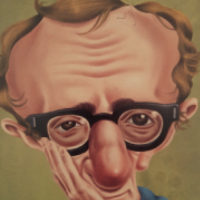
Woody Allen

Liam Neeson

Lamine Yamal

Donald Trump, por Pedro Ribeiro Ferreira


Pedro Ribeiro Ferreira recibe el Primer Premio de Caricatura
Personal de Fernão de Magalhães en el PortoCartoon 2019.-
Foto de Francisco Puñal
Humores visuales | Pedro Ribeiro Ferreira, an accidental caricaturist
Por Francisco Puñal Suárez
One of the Portuguese graphic designers and humorists who has caught my attention the most due to the excellence of his personal caricatures—several of which have been awarded in international competitions—is Pedro Ribeiro Ferreira (Lisbon, 1971).
His works have been published in Diário de Notícias, O Jogo, Exame Informática, MAGAZINE - Grande Informação, 360º FPF, Calibre 12, Bronkit, Jornal do Sporting, Stern.de, Jazz.pt, Revista Cais, Do it! magazine, cartoonmovement.com, and Cartooning for Peace.
I had the privilege of meeting Pedro in person in 2019 at the XXI PortoCartoon, when he won one of the two Special Awards for Personal Caricature, in his case, the one dedicated to the figure of Ferdinand Magellan.
His award-winning, original, and striking cartoon metaphorically showed the rugged side of this navigator by having him take a bite out of an apple-shaped globe, reflecting that his circumnavigation was an adventure that forever marked world history.
Pedro, who holds a degree in design and owns a graphic design and communication company, also teaches drawing and illustration courses to complement his activity as a caricaturist, which runs parallel to his job.
For Pedro, “drawing has always been my favorite subject; it was my best grade in school. As a child, I loved to draw.”
“I really like comics and I would like to have more time to make them. Physiognomic caricature and cartoons came later in my life as an artist, but I enjoy them very much as well. I have participated in many live caricature events and I always try to improve my technique and style.”
Personal caricature is a very difficult genre in humorous and satirical drawing. It can reveal the essence of a subject to us. The artist faces an artistic challenge, a professional test, when trying to capture the “soul” of the person being caricatured. It is by no means easy to synthesize the character of a personality in an image—that is, to capture what distinguishes them from the majority. To achieve this, the caricaturist has to conduct extensive studies of the person they want to draw: look at many photos, videos, read about their life and behavior, analyze their gestures, listen to their voice... in order to achieve, through their creative input, a drawing that expresses what the author intends.
Often, it is the subjects themselves who, through their reactions, speeches, and arguments, provide the basis for a drawing that reveals their true essence. In such cases, the artist does not have it as difficult: they can look at the subject with tenderness just as easily as with a critical and satirical tone.
Personal caricatures undoubtedly constitute a psychological examination of figures who, in one way or another, are part of the world we live in.
Pedro Ribeiro Ferreira believes that “to make a caricature, a face is enough, and that alone is a vast world to explore. It is important to try to capture the character and personality of the 'victim.' Undoubtedly, caricature is an interpretation, but the essence of that person has to be there,” he says.
I ask him, what do you think is the most important element a caricature should have?
“It must be comical, funny, and resemble the original person, but in a highly exaggerated version.”
“Everything is important,” Pedro states. “In a physiognomic caricature, the eyes, nose, and mouth are fundamental. Ideally, I would have the person of flesh and bone right in front of me, but when that is not possible, I search for images online. The choice of images and videos is crucial to the final result.”
“In my creative process,” he explains, “I first make several pencil sketches until I capture the person's essence, then I move forward with a final pencil drawing. I used to paint with gouache, colored pencils, or oil pastels, but nowadays the color is almost entirely painted using Photoshop. Every work has its story; some people are easier than others, but they all put up a fight. There are times when I go crazy because I can't catch the person. But with blood, sweat, and tears, you get there.”
“Humor,” he asserts, “is a survival instinct, a way to maintain sanity. There is a great lack of humor and satire in this world. Most people take themselves too seriously. Humor should be taught in schools, so people learn to laugh from an early age. The cartoonist has the role of alerting and encouraging the public.”
“Currently, the Portuguese press,” he expresses, “gives very little space to cartoons, and less and less over time. The press is in crisis, and cartoonists are among the first to be laid off.”
Regarding Artificial Intelligence, he notes: “I am still not sure how to properly assess the impact of AI on cartoonists' work; it is certainly a threat, and we should be very concerned. However, if used well, AI can also be a good tool, provided the author maintains their originality and style.”
(This text has been translated into English by ChatGPT)