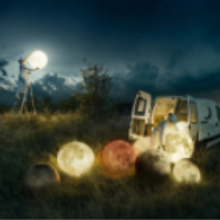
Si hay un ejemplo de cómo el ser humano es capaz de imaginar y elaborar imágenes sorprendentes, que rompen con lo establecido y la norma, y crear escenas imposibles que parecen completamente reales, ese es el trabajo del artista sueco Erik Johansson. Él mismo define su estilo como “surrealismo fotorrealista”.
La gracia de sus imágenes está precisamente en que, al principio, el espectador puede creer que está viendo una fotografía normal, hasta que descubre algo que quiebra las reglas de la realidad. Uno disfruta del humor, lo inconcebible, y lo exagerado, que están presentes en sus imágenes, que se construyen combinando numerosas fotografías, cuidadosamente integradas mediante edición digital.
Aunque la escena sea imposible, la iluminación, las sombras, las texturas, la perspectiva y las proporciones buscan que el resultado parezca una fotografía auténtica. Erik juega con la percepción del espectador y con las leyes normales del espacio, la escala y la gravedad. Muchas obras contienen un toque humorístico o una idea inesperada, además del componente surrealista. Su obras exigen mucho trabajo de planificación: normalmente parte de un boceto o una idea y después fotografía por separado los elementos que necesita para construir la imagen definitiva.
Nacido en 1985, en Suecia, este artista visual está radicado en Praga, República Checa. Estudió Ingeniería Informática en la Universidad Tecnológica de Chalmers, en Gotemburgo (Suecia), entre 2005 y 2010. Se graduó en 2010 con un máster en Diseño de Interacción.
Erik se centra principalmente en proyectos personales y exposiciones, y su enfoque de la fotografía es singular, ya que busca capturar ideas en lugar de momentos. Valiéndose de su cámara y su imaginación, se esfuerza por crear una imagen única y realista que cuente una historia. En esencia, trabaja para resolver el desafío de cómo capturar lo imposible.
Erik no utiliza material generado por computadora o inteligencia artificial, ni ilustraciones o imágenes de archivo; se basa exclusivamente en complejas combinaciones de sus propias fotografías. Este proceso requiere mucho tiempo, por lo que solo produce unas diez obras nuevas al año.
“Soy autodidacta -expresa- tanto en fotografía como en retoque digital. Descubrí lo divertido que era modificar fotos por puro entretenimiento en el año 2000, cuando conseguí mi primera cámara digital. Llevo dibujando desde que tengo uso de razón y, al tener la cámara, sentí que quería hacer algo más con las imágenes. Empecé a experimentar con ellas en el ordenador y descubrí la manipulación fotográfica. Para mí, el realismo siempre ha sido fundamental, y supone un reto lograr que un boceto cobre vida en una fotografía. Aprendí a base de probar; llevó su tiempo y sigo aprendiendo, pero una vez que dominas los fundamentos de las herramientas, el único límite es la imaginación”.
“Me inspiro -añade- en todo lo que me rodea: desde cosas que veo en mi vida cotidiana hasta la obra de otros artistas o la música. Creo que se trata, en gran medida, de observar el mundo desde una perspectiva diferente. Encuentro más inspiración en los pintores que en los fotógrafos”.¿
“Aquí tienes algunos artistas que me inspiran”:
M.C. Escher – Artista gráfico neerlandés
René Magritte – Artista surrealista belga
Sven Nordqvist – Ilustrador y autor sueco
Thomas Öberg – Cantante de bob hund
Rob Gonsalves – Pintor canadiense
Jacek Yerka – Pintor polaco
Salvador Dalí – Pintor surrealista español
Shaun Tan – Ilustrador australiano
Mattias Adolfsson – Ilustrador sueco
Sobre su proceso creativo explica que se divide en tres partes distintas:
“Todo comienza siempre con un boceto, una idea sencilla. No muchas ideas llegan a materializarse, pero si considero que una es lo suficientemente buena, decido intentar llevarla a cabo”.
“La primera parte es la planificación. Una vez que tengo una idea que considero válida para realizarla, debo buscar los lugares que necesito fotografiar para componer la imagen final. Esto puede llevar desde unos pocos días hasta varios meses, o incluso años. Es el paso más importante, ya que define el aspecto y la atmósfera de la fotografía; constituye mi materia prima. Esta etapa también implica resolver problemas técnicos: cómo lograr que la perspectiva, los reflejos, los materiales y la iluminación, entre otros elementos, resulten realistas”.
“La segunda parte consiste en la toma o recopilación del material. Nunca utilizo fotografías de archivo en mis proyectos personales; siempre quiero tener el control total de mis imágenes y sentir que he realizado todo el trabajo por mi cuenta. Esto me limita en el sentido de que no puedo llevar a cabo todas las ideas que tengo, pero las limitaciones a veces son positivas para definir la obra. Mantener una iluminación y una perspectiva coherentes es fundamental para lograr un resultado realista al combinar las fotografías”.
“La fase final es la composición de las imágenes. Este proceso puede durar desde unos pocos días hasta varias semanas. En realidad, es el paso más sencillo, siempre y cuando haya realizado un buen trabajo en las dos etapas anteriores. Esta parte es como un rompecabezas: tengo todas las piezas y solo necesito ensamblarlas”.¿
Los lectores de Humor Sapiens para que tengan una idea de cómo Erik toma varias fotos y elabora su montaje, pueden ver este vídeo espectacular:
https://www.youtube.com/watch?


The Surrealist Art of Sweden's Erik Johansson
By Francisco Puñal Suárez
If there is an example of how human beings are capable of imagining and creating astonishing images that break with the established norm, and of building impossible scenes that look completely real, it is the work of the Swedish artist Erik Johansson. He himself defines his style as "photorealistic surrealism."
The charm of his images lies precisely in the fact that, at first, viewers may believe they are looking at an ordinary photograph, until they discover something that breaks the rules of reality. One enjoys the humor, the inconceivable, and the exaggerated elements present in his images, which are built by combining numerous photographs, carefully blended through digital editing.
Even though the scene is impossible, the lighting, shadows, textures, perspective, and proportions are all meant to make the result look like an authentic photograph. Erik plays with the viewer's perception and with the normal laws of space, scale, and gravity. Many works contain a touch of humor or an unexpected idea, in addition to the surrealist element. His works demand a great deal of planning: he normally starts from a sketch or an idea and then photographs separately the elements he needs to build the final image.
Born in 1985 in Sweden, this visual artist is based in Prague, Czech Republic. He studied Computer Engineering at Chalmers University of Technology in Gothenburg, Sweden, from 2005 to 2010. He graduated in 2010 with a master's degree in Interaction Design.
Erik focuses mainly on personal projects and exhibitions, and his approach to photography is unique, since he seeks to capture ideas rather than moments. Using his camera and his imagination, he strives to create a unique, realistic image that tells a story. In essence, he works to solve the challenge of how to capture the impossible.
Erik does not use computer-generated or artificial intelligence material, nor illustrations or stock images; he relies exclusively on complex combinations of his own photographs. This process is very time-consuming, so he produces only about ten new works a year.
"I'm self-taught," he says, "both in photography and in digital retouching. I discovered how fun it was to modify photos purely for entertainment in the year 2000, when I got my first digital camera. I've been drawing for as long as I can remember, and once I had the camera, I felt I wanted to do something more with images. I started experimenting with them on the computer and discovered photo manipulation. For me, realism has always been fundamental, and making a sketch come to life in a photograph is a challenge. I learned by trial and error; it took time and I'm still learning, but once you master the basics of the tools, the only limit is your imagination."
"I draw inspiration," he adds, "from everything around me: from things I see in my everyday life to the work of other artists or music. I think it's largely about looking at the world from a different perspective. I find more inspiration in painters than in photographers."
"Here are some artists who inspire me":
- M.C. Escher – Dutch graphic artist
- René Magritte – Belgian surrealist artist
- Sven Nordqvist – Swedish illustrator and author
- Thomas Öberg – Singer of bob hund
- Rob Gonsalves – Canadian painter
- Jacek Yerka – Polish painter
- Salvador Dalí – Spanish surrealist painter
- Shaun Tan – Australian illustrator
- Mattias Adolfsson – Swedish illustrator
Regarding his creative process, he explains that it is divided into three distinct parts:
"It always begins with a sketch, a simple idea. Not many ideas make it to realization, but if I consider one good enough, I decide to try to carry it out."
"The first part is planning. Once I have an idea I consider worth pursuing, I have to find the places I need to photograph in order to compose the final image. This can take anywhere from a few days to several months, or even years. It is the most important step, since it defines the look and atmosphere of the photograph; it is my raw material. This stage also involves solving technical problems: how to make the perspective, reflections, materials, and lighting, among other elements, look realistic."
"The second part is shooting or gathering the material. I never use stock photos in my personal projects; I always want to have full control over my images and feel that I've done all the work on my own. This limits me in the sense that I can't carry out every idea I have, but limitations can sometimes be good for defining the work. Maintaining consistent lighting and perspective is essential to achieve a realistic result when combining the photographs."
"The final phase is composing the images. This process can last from a few days to several weeks. It's actually the easiest step, as long as I've done a good job in the previous two stages. This part is like a jigsaw puzzle: I have all the pieces and I just need to assemble them."
For the readers of Humor Sapiens, to get an idea of how Erik takes several photos and puts together his montage, you can watch this spectacular video:
https://www.youtube.com/watch?v=6gHmKBym2pc
(This text has been translated into English by ChatGPT)