1996-2026
Revistas modernas de humor y sátira desde la independencia de Croacia hasta la actualidad
Žulj (1995. – 1999.), revista de humor y sátira de Split, publicada por STRIP d.o.o. de Split, editada por Čedo Pocrnić. El primer número se publicó en mayo de 1995. Marko Ivić (caricaturista) es mencionado como el creador de la revista en cooperación con conocidos caricaturistas como Žarko Luetić, Nikola Listeš y Pocrnić. La revista dejó de publicarse después de un tiempo, un destino que corrieron otras revistas similares de aquella época.
Feral Tribune (1993.-2008.) se publicó durante 15 años completos y es, sin duda, el semanario croata más provocador pero también el más galardonado. Ganador de los premios "Veselko Tenžera" y "Stefanel", del Premio Internacional a la Libertad de Prensa otorgado por el International Press Directory, de la "Pluma de Oro de la Libertad" y reconocido como el mejor semanario político-satírico del mundo. Se publicaba los viernes, y ya el día anterior se podía encontrar en los quioscos de Zagreb. Todo su contenido estaba disponible en su sitio web oficial, por lo que en marzo de 2010 se publicaron todos los números de "Feral" en cuatro DVD. Fue fundado en junio de 1993, el editor en jefe fue Heni Erceg y el editor fue Kultura i rasvjeta d.o.o. Para el "Feral", de orientación política de izquierda, escribieron periodistas que más tarde se consolidaron: Boris Dežulović, Drago Hedl, Viktor Ivančić y otros, quienes a menudo recibían amenazas debido a la publicación de sus textos comprometedores relacionados principalmente con la política, escándalos de corrupción, crímenes en la Guerra de la Independencia, etc. El periódico era conocido por burlarse del gobierno del HDZ, erosionando la reputación del partido gobernante, con una sátira muy aguda y provocadora dirigida al primer presidente croata, Franjo Tuđman, por lo que fue censurado y estuvo bajo la constante vigilancia del gobierno, principalmente debido a sus portadas desafiantes, un enfoque marcadamente crítico, paráfrasis y fotomontajes por los cuales eran reconocibles. Inicialmente se publicó como un suplemento del entonces "Nedjeljna Dalmacija", y en 1989 Viktor Ivančić, Predrag Lucić y el ya mencionado Dežulović lo ampliaron y enriquecieron textualmente de manera significativa. Los críticos reprochaban al semanario su falta de objetividad y su carácter ofensivo. Debido a las numerosas acusaciones, se llevaron a cabo procedimientos judiciales contra sus periodistas. El 15 de junio de 2008, debido a la acumulación de problemas financieros y a la interrupción unilateral de las negociaciones por parte de EPH, Feral Tribune publicó su último número.
Zagorski Potepuh (1996.-2002.), posteriormente Potepuh (2002.-2023.), fue la única revista impresa de humor y sátira en Croacia (desde 2018 renombrada como revista croata de humor, sátira y aforismos). El editor en jefe durante todo el periodo de su publicación fue el periodista, publicista y humorista Dragutin Lončar. La revista se publicaba en Donja Stubica con fondos propios y con la ayuda de empresarios locales, y era impresa por la pequeña editorial "L. D. Baltazar" de Oroslavje. Esta revista, con un diseño muy rico, publicaba sátiras, aforismos, caricaturas, parodias, poemas satíricos, horóscopos humorísticos y similares. La primera y la última página eran a color, mientras que la sección central (unas treinta páginas de formato A4) estaba impresa en blanco y negro. En las últimas 3 o 4 páginas se encontraban anuncios publicitarios ilustrados de los patrocinadores. Para Potepuh escribieron e ilustraron numerosos humoristas y satíricos croatas de todas las partes del país: Pajo Kanižaj, Marko Grgičević, Tomislav Supek, Josip Balaško, Mladen Vuković, Ivo Mijo Andrić, Danko Ivšinović, Živko Prodanović, Abdurahman Halilović Ahil, Marinko Mijović, Savo Ilić, Tomislav Mihanović, Svetislav Biljanović, Martin Jakšić, Boris Nazansky, Tonka Lovrić, Zvonko Gregurović, Milan Rupčić, Nađan Dumanić, Zvonimir Babić, Darko Ciglenečki, Dražen Jergović, kao i karikaturisti: Oto Reisinger, Ivan Haramija Hans, Stanko Zmazek, Branko Medak, Slobodan Butir, Borislav Hegedušić, Živko Nimac, Rajko Šobak, Zoran Tkalec, Damir Novak, Zdenko Puhin, Predrag Raičević, Krešimir Kveštek y muchos otros. El último número se publicó en febrero de 2023.
Hrvatski zvekan (2002.), revista de sátira y otros asuntos — publicación para la izquierda y la derecha — fue editada por Mladen Ivezić. Solo se publicaron cuatro números entre abril y julio de 2002, lo que la convierte claramente en una revista ilustrada mensual publicada en Zagreb en páginas de 41 cm de altura. También era conocida como Mudri zvekan ("El Zvekan Sabio") y Veseli zvekan ("El Zvekan Alegre").
Čvoka (2000–2015) fue la primera publicación humorística croata en internet, disponible desde su lanzamiento el 1 de abril de 2000 en la dirección web www.imotski.hr. Publicaba algunos de los textos del programa de radio "Kad se smijah tad i bijah" ("Cuando me reía, allí estaba yo") de HRT Radio Split, así como selecciones de nuevos libros de aforismos y epigramas, elegidos por el redactor jefe Mladen Vuković, actual presidente de la asociación UHAH, quien también fue el presentador de larga trayectoria (durante más de treinta años) del mencionado programa de humor radiofónico, a través del cual reunió lo mejor del humor de Dalmacia y Herzegovina. La publicación continuó su vida virtual en el citado dominio web. Los primeros treinta números de Čvoka se publicaron exclusivamente en el sitio web e incluían suplementos multimedia (audio y vídeo). Los números 30–50 están disponibles para descarga gratuita aquí: https://api.hrt.hr/media/9c/18/cvoka-2008-2015-web-br-30-50-20220324195000.pdf Se publicaba el primer día y más tarde el día 13 de cada trimestre, y al igual que publicaciones electrónicas similares, incluía sátira política de actualidad, parodias de eventos sociales y similares. [Entre los colaboradores externos habituales del programa y posteriormente de la publicación se encontraban: Ivan Delaš – Baba Manda, Marijan Grbavac – Kumić Ikić, el profesor Nađan Dumanić, Mara Ožić-Bebek Imotica, Mejrema Reuter como Mara Štikadenta... Además de Mladen Vuković, los textos también fueron escritos por Jandre Drmić, Tomislav Mihanović, Miljenka Koštro, Josip Grgić, Drago Maršić, Josip Margeta, Augustin Ago Kujundžić, Marinko Radovčić, Stanislav Maroja, Tomislav Supek, Marinko Bašić, Robert Marić, Tonka Lovrić, Ivo Cetinić Paron, Davor Bobanac, Borivoj Jelinčić y otros humoristas croatas. Se cultivaban constantemente los dialectos locales, por ejemplo a través del chakaviano, el ikaviano dálmata-zagoriano (y durante un tiempo el ikaviano bunjevac de Ivan Ivković Ivandekić). Durante varias temporadas, los textos fueron leídos en "media hora de risas" por los actores del Teatro Nacional Croata de Split: Arijana Čulina, Milan Štrljić, Filip Radoš, Ratko Glavina y los ya fallecidos Ilija Zovko, Ante Čedo Martinić y Franko Strmotić...] Alegando razones económicas que impedían continuar con las emisiones tras 33 años completos (los años de Cristo) y 1.250 episodios, el último y alegre programa de radio de la emisora pública HRT fue cancelado a mediados de 2024, a pesar de haber sido nominado al Premio al Programa de Radio del Año y al prestigioso galardón "Rosa de Večernjak" en 2019. [Fuente: https://radio.hrt.hr/slusaonica/kad-se-smijah-tad-i-bijah]
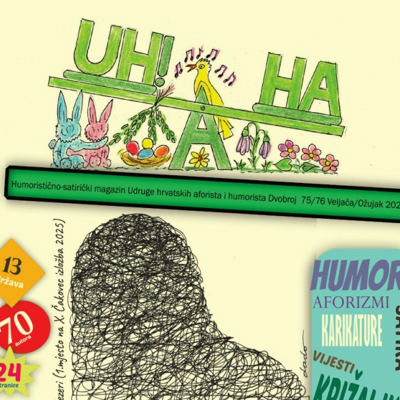
Uh!Aha (2019) es una revista electrónica croata (y cada vez más internacional) de humor, sátira, aforística y caricatura. Es el boletín electrónico oficial de la Asociación de Aforistas y Humoristas Croatas (UHAH), lanzado a finales de 2019 al inicio de la expansión global del virus Covid-19. La revista pretendía animar a las personas a crear (escribir y dibujar) mientras mantenían el distanciamiento social en sus hogares, creando al mismo tiempo una plataforma para fomentar el buen humor — un lugar de risas y entretenimiento a distancia para sus lectores. La versión original fue concebida y realizada por el redactor jefe Dražen Jergović, a quien pronto se unieron colegas de la asociación UHAH (Nađan Dumanić diseñó el logotipo adaptable de la portada y Damir Markulj mejoró el diseño gráfico de la revista) y otros colaboradores de todas partes de Croacia. En un principio, hasta el número 24, la publicación apareció en el formato A3 más grande con 12 páginas para facilitar la lectura a los lectores de mayor edad, pero posteriormente se pasó al formato A4 estándar, aumentando el número de páginas a 24, cifra que se mantiene hasta hoy. Dado que, tras casi seis años de publicación, ningún patrocinador ha aportado donaciones y la audiencia sigue siendo modesta debido a la escasa promoción, Uh!Aha sigue siendo gratuita para los lectores. Los últimos números están disponibles aquí: https://pubhtml5.com/homepage/opdvy/. A lo largo de los 76 números publicados hasta la fecha, han colaborado casi un centenar de autores y autoras de más de veinte países de todo el mundo. Cada número contiene humor de actualidad, sátira mordaz, caricaturas temáticas, las últimas noticias del mundo del humor, la sátira y la aforística, así como el imprescindible rincón de pasatiempos con crucigrama. Una característica distintiva de la publicación es la inclusión de formas cómicas poco conocidas que no se encuentran en ningún otro lugar (historias con la misma letra inicial, foto-palíndromos, juegos de palabras lingüísticos, cinismos, infantilismos, controanagramas, grotescas, lapsus, parodias de nombres de personajes públicos). Junto a Dražen, el actual equipo editorial está formado por Mladen Vuković, Nađan Dumanić, Damir Markulj y el prof. Matej Delaš.
Zlatna Smoliga (2021–2025) fue una publicación humorística de Mali Mihaljevec, en el norte de Croacia, fundada por el vecino del lugar y caricaturista Damir Novak. Se publicaba en ocho páginas ricamente decoradas con colores en el formato B4. Predominaban los chistes gráficos, las caricaturas y los cómics, mientras que aproximadamente una cuarta parte del espacio disponible estaba reservada a textos humorístico-irónicos. En la revista publicaban todos los miembros actualmente en activo de la Sociedad Croata de Caricaturistas, así como humoristas principalmente de Međimurje y del norte y centro de Croacia. Debido a la trágica muerte del redactor jefe, la revista dejó de publicarse en 2026.
Apolon (2023) es una revista electrónica croata de humor y sátira lanzada por iniciativa propia por el zapatero jubilado, aficionado a los chistes y escritor (y más tarde autodidacta del dibujo) Ivan Grahovec. Se publica trimestralmente como edición electrónica cada tres meses, con entre 22 y 28 páginas en formato A4, en el blog y plataforma del autor (https://anyflip.com/homepage/pmxsu/preview). La revista cuenta con contribuciones de autores de Croacia y de los países vecinos del mismo ámbito lingüístico, mientras que las caricaturas se envían desde Europa y Brasil. La publicación está repleta de excelentes chistes gráficos, cómics, caricaturas, chistes, humoradas, aforismos, poemas y críticas satíricas del mundo que nos rodea. El número 15 está próximo a salir.
La revista Karika es el boletín oficial de la Sociedad Croata de Caricaturistas (http://www.hdk.hr/). Se publica desde 1940 — ya durante 85 años completos — y es el único periódico en Croacia especializado en noticias del mundo de la caricatura, presentando a autores premiados, concursos y promoviendo el ingenio gráfico de hábiles ilustradores con una aguda visión satírica de la realidad. Karika se publica en 24 páginas ricamente presentadas en formato A4. El editor del actual número 85, correspondiente a 2025, es Tin Horvat; entre los editores anteriores figuran Petar Pismestrović, Ico Voljevica, Tomislav Ožanić, Davor Štambuk, Zdenko Puhin, Davor Trgovčević, Milan Lekić, Nikola Plečko, Predrag Raičević y muchos otros.
Junto a la revista electrónica Uh!Aha, la revista electrónica Apolon es hoy la única publicación de humor y sátira en Croacia que se edita de forma regular y en régimen exclusivamente voluntario, sin ningún apoyo de las instituciones culturales competentes — un testimonio de décadas de marginación y del paulatino desarraigo de la literatura entretenida y educativa del panorama mediático nacional. Confiemos en que pronto lleguen tiempos mejores para los humoristas y satíricos croatas.


(Izvori tekstova/citata, slika i naslovnica:
- bibliografski zapisi Kataloga knjižnice Grada Zagreba i Grada Splita (digitalna građa), https://njuskalo.hr, https://kupindo.com, https://antikvarijatstaklenigrad.hr/ i https://radio.hrt.hr/radio-split ), https://lupiga.com/
https://hr.wikipedia.org/wiki/Feral_Tribune
https://www.enciklopedija.hr/clanak/feral-tribune
Croatian Humor Magazines (Part 7)
By Dražen Jergović
(1996–2026)
Modern humorous-satirical magazines from the period of Croatian independence onward
Žulj (1995–1999) was a humorous-satirical newspaper from Split, published by STRIP d.o.o. in Split and edited by Čedo Pocrnić. The first issue appeared in May 1995. Cartoonist Marko Ivić is mentioned as one of the creators of the paper in cooperation with well-known cartoonists such as Žarko Luetić, Nikola Liste, and Pocrnić. The paper ceased publication after a certain time, which was the fate that befell many similar publications of that period.
Feral Tribune (1993–2008) was published for a full fifteen years and was certainly the most provocative and also the most award-winning Croatian weekly newspaper. It received awards such as the “Veselko Tenžera,” “Stefanel,” the International Press Directory award, and the “Golden Pen of Freedom,” and was considered one of the best political-satirical weeklies in the world. It was published on Fridays, though it could often be found at kiosks a day earlier in Zagreb, and all of its content was available on its official website, so in March 2010 all issues of Feral were released on four DVDs.
It was founded in June 1993. The editor-in-chief was Heni Erceg, and the publisher was Kultura i rasvjeta d.o.o. The politically left-oriented Feral featured writers who later became established journalists: Boris Dežulović, Drago Hedl, Viktor Ivančić, among others, who frequently received threats because of their compromising texts dealing mainly with political corruption scandals, war crimes, and similar subjects.
The newspaper was known for mocking the HDZ government, undermining the reputation of the ruling party, and for its sharp provocative satire directed particularly at the first Croatian president, Franjo Tuđman. Because of this it was censored and constantly monitored by the authorities, especially due to its provocative covers, highly critical approach, paraphrases, and photomontages for which it became recognizable.
Originally it appeared as a supplement to Nedjeljna Dalmacija, but in 1989 it was significantly expanded and textually enriched by Viktor Ivančić, Predrag Lucić, and Boris Dežulović. Critics accused the weekly of bias and offensiveness. Numerous lawsuits were filed against its journalists. On June 15, 2008, due to accumulated financial problems and unilateral termination of negotiations by EPH, Feral Tribune published its final issue.
Zagorski Potepuh (1996–2002), later simply Potepuh (2002–2023), was the only printed humor-satirical magazine in Croatia (since 2018 subtitled Croatian Magazine for Humor, Satire and Aphorisms). Its editor-in-chief throughout its publication history was journalist, publicist, and humorist Dragutin Lončar.
The magazine was published in Donja Stubica with the help of local businessmen and printed by the small publishing house “L.D. Baltazar” from Oroslavje. It was a richly designed magazine publishing satire, aphorisms, caricatures, parodies, mocking poems, humorous horoscopes, and more. The front and back pages were in color, while the middle section (around thirty A4 pages) was printed in black and white. The last three or four pages contained small illustrated advertisements from sponsors.
Zagorski Poteph (1996–2002), followed by Potepuh (2002–2023), was the only printed humor-satirical magazine in Croatia (since 2018 the last remaining magazine for humor, satire and aphorisms). Its chief editor throughout its existence was journalist, publicist and humorist Dragutin Lončar. The magazine was published in Donja Stubica with private funds and with the support of local sponsors, and it had a small print run. D. Baltazar and Zoroslav. Very rich in content, the magazine published satire, aphorisms, caricatures, parodies, humorous poems, witty horoscopes, and more. The first and some later issues were in color, while the middle section (around thirty A4 pages) was printed in black and white. The final 3–4 pages contained short comic advertisements and calls. For Potepuh wrote nearly all Croatian humorists and satirists from all regions of the country: Pajo Kanižaj, Marko Grčičević, Tomislav Supek, Josip Balaško, Mladen Vuković, Ivo Mijo Andrić, Danko Ivšinović, Živko Prodanović, Abdurahman Halilović Ahil, Marinko Mijović, Savo Ilić, Tomislav Mihanović, Svetislav Biljačinović, Martin Jašek, Boris Nazansky, Tonka Lovrić, Zvonko Gregurović, Milan Rupčić, Nadan Dumanić, Zvonimir Babić, Darko Ciglenecžki, Dražen Jergović, as well as caricaturists: Oto Reisinger, Ivan Haramija Hans, Stanko Zmazek, Branko Medak, Slobodan Butir, Borislav Hegedušić, Živko Nimac, Rajko Šobak, Zoran Tkalec, Damir Novak, Zdenko Puhin, Predrag Račević, Krešimir Kvestek and many others. The last issue was published in February 2023.
Hrvatski zvekan (2002), a magazine for satire and other matters — a publication for the left and the right — was edited by Mladen Ivezić. Only four issues were published between April and July 2002, making it clearly an illustrated monthly published in Zagreb on pages measuring 41 cm in height. It was also known as Mudri zvekan ("The Wise Zvekan") and Veseli zvekan ("The Merry Zvekan").
Čvoka (2000–2015) was the first Croatian internet humor publication, available from its launch on April 1, 2000, at the web address www.imotski.hr. It published some of the texts from the radio show "Kad se smijah tad i bijah" ("When I Laughed, There I Was") on HRT Radio Split, as well as selections from new books of aphorisms and epigrams, chosen by editor-in-chief Mladen Vuković, current president of the UHAH association, who was also the long-standing host (for more than thirty years) of the aforementioned humor radio show, through which he gathered the best of humor from Dalmatia and Herzegovina. The publication continued its virtual life on the aforementioned web domain. The first thirty issues of Čvoka were published exclusively on the website and included multimedia (audio and video) supplements. Issues 30–50 are available for free download here: https://api.hrt.hr/media/9c/18/cvoka-2008-2015-web-br-30-50-20220324195000.pdf It was published on the first, and later on the 13th day of each quarter, and like similar e-publications it featured current political satire, parodies of social events, and the like. [Regular external contributors to the show and later to the publication included: Ivan Delaš – Baba Manda, Marijan Grbavac – Kumić Ikić, Professor Nađan Dumanić, Mara Ožić-Bebek Imotica, Mejrema Reuter as Mara Štikadenta... In addition to Mladen Vuković, texts were also written by Jandre Drmić, Tomislav Mihanović, Miljenka Koštro, Josip Grgić, Drago Maršić, Josip Margeta, Augustin Ago Kujundžić, Marinko Radovčić, Stanislav Maroja, Tomislav Supek, Marinko Bašić, Robert Marić, Tonka Lovrić, Ivo Cetinić Paron, Davor Bobanac, Borivoj Jelinčić, and other Croatian humorists. Local dialects were consistently cultivated, for example through Chakavian, the Dalmatian-Zagorian Ikavian dialect (and for a time the Bunjevac Ikavian dialect of Ivan Ivković Ivandekić). For several seasons, texts were read in "half an hour of laughter" by actors of the Croatian National Theatre Split: Arijana Čulina, Milan Štrljić, Filip Radoš, Ratko Glavina, and the late Ilija Zovko, Ante Čedo Martinić, and Franko Strmotić...] Citing financial reasons as making it impossible to continue broadcasting after a full 33 (Jesus) years and 1,250 episodes, the last cheerful radio show on the public broadcaster HRT was discontinued in mid-2024, despite having been nominated for Radio Show of the Year and the prestigious "Večernjakova ruža" award in 2019. [Source: https://radio.hrt.hr/slusaonica/kad-se-smijah-tad-i-bijah]
Uh!Aha (2019) is a Croatian (and increasingly international) electronic magazine for humor, satire, aphorisms, and caricature. It is the official e-publication of the Association of Croatian Aphorists and Humorists (UHAH), launched in late 2019 at the beginning of the global spread of the Covid-19 virus. The magazine aimed to encourage people to create (write and draw) while maintaining social distancing at home, while simultaneously creating a platform for fostering a cheerful spirit — a place for laughter and remote relaxation for its readers. The original version was conceived and realized by editor-in-chief Dražen Jergović, who was soon joined by colleagues from the UHAH association (Nađan Dumanić designed the adaptable cover logo, and Damir Markulj improved the magazine's graphic design) and other contributors from all parts of Croatia. Initially, up to issue 24, the publication appeared in the larger A3 format with 12 pages for better readability for older readers, but later switched to the standard A4 format with the number of pages increased to 24, which remains the case today. Given that, after nearly six years of publication, no sponsors have contributed donations, and readership remains modest due to limited promotion, Uh!Aha remains free to readers. The latest issues are available here: https://pubhtml5.com/homepage/opdvy/. Across the 76 issues published so far, nearly a hundred authors from more than twenty countries worldwide have been featured. Each issue contains topical humor, sharp satire, themed caricatures, the latest news from the world of humor, satire, and aphorisms, as well as the unmissable puzzle corner with a crossword. A distinctive feature of the publication is the inclusion of lesser-known comic forms not found elsewhere (stories using the same initial letter, photo-palindromes, linguistic puns, cynics, infantilisms, counter-anagrams, grotesques, slips of the tongue, parodies of public figures' names). Along with Dražen, the current editorial team consists of Mladen Vuković, Nađan Dumanić, Damir Markulj, and Prof. Matej Delaš.
Zlatna Smoliga (2021–2025) was a humor publication from Mali Mihaljevec in northern Croatia, founded by local resident and caricaturist Damir Novak. It was published across eight richly and colorfully decorated pages in the larger B4 format. Graphic gags, caricatures, and comics predominated, while approximately a quarter of the available space was reserved for humorous and ironic texts. The magazine featured contributions from all currently active members of the Croatian Caricaturists' Society, as well as humorists mainly from Međimurje and northern and central Croatia. Due to the tragic death of the editor-in-chief, the magazine ceased publication in 2026.
Apolon (2023) is a Croatian humor and satire e-magazine launched on his own initiative by retired cobbler, joke enthusiast, and writer (and later self-taught illustrator) Ivan Grahovec. It is published quarterly as an electronic edition every three months, spanning 22–28 pages in A4 format, on the author's blog and platform (https://anyflip.com/homepage/pmxsu/preview). The magazine features contributions from authors in Croatia and neighboring countries of the same linguistic area, while caricatures are submitted from Europe and Brazil. The publication is full of excellent graphic gags, comics, caricatures, jokes, humoresques, aphorisms, poems, and satirical critiques of the world around us. The 15th issue is coming soon.
Karika magazine is the official publication of the Croatian Caricaturists' Society (http://www.hdk.hr/). Published since 1940 — now for a full 85 years — it is the only newspaper in Croatia specializing in news from the world of caricature, featuring award-winning authors, competitions, and promoting the graphic wit of skilled illustrators with a sharp satirical view of reality. Karika is published across 24 richly presented A4 pages. The editor of the current 85th issue from 2025 is Tin Horvat; previous editors included Petar Pismestrović, Ico Voljevica, Tomislav Ožanić, Davor Štambuk, Zdenko Puhin, Davor Trgovčević, Milan Lekić, Nikola Plečko, Predrag Raičević, and many others.
Alongside the e-magazine Uh!Aha, the e-magazine Apolon is today the only humor and satire publication in Croatia that is regularly published on a purely voluntary basis, without any support from the relevant cultural institutions — a testament to decades of marginalization and the gradual eradication of entertaining and educational literature from the domestic media landscape. Let us hope that better times are coming soon for Croatian humorists and satirists.
(This text has been translated into English by ChatGPT)