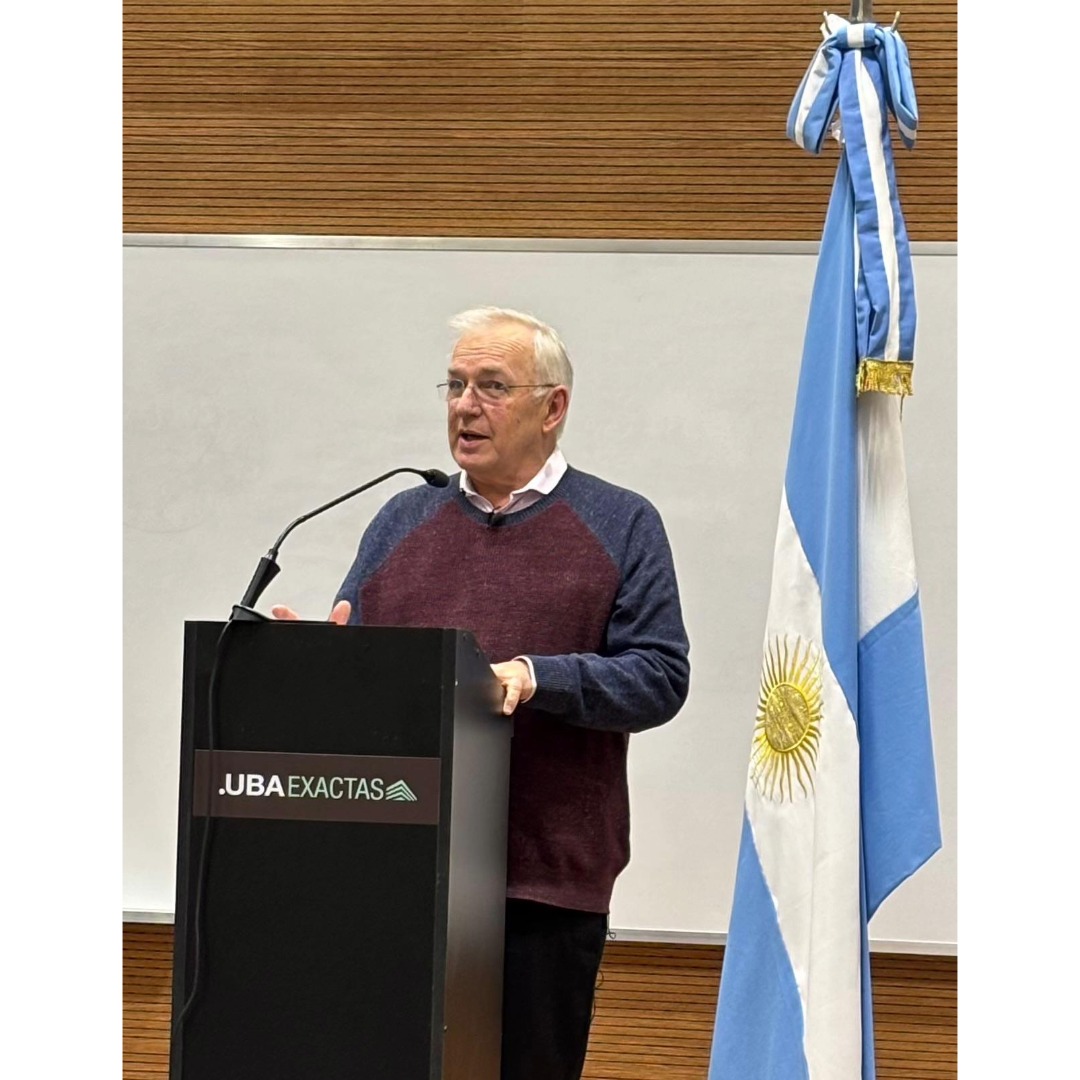
Ceremonia de recepción del título de Doctor Honoris Causa de la UBA
Luis Pescetti
Rector, Decano, señoras y señores.
Yo era un docente que no se había propuesto hacer canciones de humor para chicos, pero en una clase me reclamaron “Maestro, esas canciones son para nenes chiquitos”. Me quedé de una pieza, tenía más de cien canciones con lo mejor del repertorio de entonces… y ellos eran la salita de cinco.
Así empezó. El día que vi a uno, encandilado por una compañerita que no le prestaba atención, me di cuenta de que mi repertorio no tenía historias con chicos y familias reales: entonces compuse la primera, una en la que el protagonista se hace pipí al ver a su chica. Ese narrador en primera persona muestra que no hay vergüenza en perder el control por amor. Lo de hacerse pipí, le ocurría a uno de la sala de cuatro, cuando me veía entrar al salón. Poner al narrador como protagonista diluye el lugar de poder de quien señala, pues es un par al que le ocurre lo mismo. De esta manera, el error no avergüenza, y transmite que “las reglas de la corte” no deben intimidarnos.
Respondieron con una risa que no se termina al día de hoy.
Una vez frené en un semáforo y, por el paso de cebra, cruzó una mamá con un hijo de unos diez años, que iba adelante y otro de unos cuatro, que avanzaba tropezándose en uno de esos triciclos de plástico.
La mamá se impacientó y lo retó tironeándolo del brazo. Entonces, vi cómo se dibujaba una gran sonrisa en la cara del mayor. Ahí está, pero si hiciéramos una canción sobre la paciencia entre hermanos, lo perdemos. Porque el mayor sabía qué se esperaba de él. Si machacamos con el ideal, los chicos sienten lo mismo que cuando nos invitan a una merienda, y pescamos que es para vendernos un tiempo compartido. Mejor como en los boleros, no discutir con la emoción: “Por fin mi mamá lo devolverá”. Y se reiría, sintiéndose reconocido en su inteligencia. La de “los hermanos deben amarse” tiene ese aire de campaña evangelizadora que, en verdad, cree que “los salvajes son incorregibles”.
Representa una foto y no: una película que se desarrollará.
Pero, ¿cuándo aprendimos a vernos como una foto que no cambia?
Una mañana, en un acto escolar en Cuernavaca, dejó de funcionar la amplificación. La directora miró el micrófono con desencanto y exclamó: “Ya tronó”. Esa expresión resalta, no el desperfecto, sino que era esperable.
En Latinoamérica, nuestros chicos crecen oyendo sobre el fracaso o la corrupción del país, sus instituciones y funcionarios; siempre unido a “lo esperable” que sea así. El descreimiento está internalizado en los medios y las charlas cotidianas: “No va a cambiar”, “en otro país, esto no pasaría”.
Es un Chernóbil de autorrepresentación.
Vivir en México y trabajar por Latinoamérica me recordó que Argentina fue parte de una colonia, pero no nos pensamos así. Luego siguió una cadena de autoritarismos, modelos de dependencia; y se nos escapa lo arraigada que tenemos esa mirada colonial. La metrópoli nos administró, beneficiándonos con civilidad y progreso, porque los nativos éramos desobligados, ruinosos para nosotros mismos.
Después la colonia se va, la mirada queda. Si algo sale mal, no nos sorprende, somos incorregibles, yestamos en la loma del peludo. Dios está en todas partes, pero atiende en Madrid, que para colmo no es Nueva York, ni París, ni Berlín. Y para casi todo, toca peregrinar a Buenos Aires.
Por ejemplo, yo crecí en San Jorge, sobre la ruta provincial 13. Si la maestra pedía un libro, íbamos a una papelería que lo encargaba a Santa Fe o a Rosario, que lo traía desde Buenos Aires. Lo mismo con los repuestos, y hasta los programas de radio y televisión, que no siempre eran en vivo.
La inspectora escolar llegaba en un Fitito. El día anterior mi vieja lavaba el guardapolvo y les pasaba tiza a las zapatillas, para blanquearlas. A la mañana siguiente, el silencio era absoluto, no se movían ni los peores de la clase. El director saludaba y anunciaba la visita con tono severo. Ella inclinaba la cabeza y luego recorría las aulas, se sentaba al fondo. A la profesora, le temblaba el libro en las manos. Y lo más extraordinario es que todos sabíamos que viajaba con un mono tití en el Fitito, lo dejaba esperándola en el auto con la ventanilla ligeramente abierta, para que respirara sin asarse por el calor santafecino.
Circulaban algunos chistes, por supuesto.
Se salía a dar la vuelta al pueblo a ver vidrieras, atentos a las novedades, pero ¿quién se interesaba en las nuestras?
En la confitería del Jockey Club, se juntaban abogados, escribanos, el comisario no, pero el juez de paz sí. Los médicos eran una categoría aparte: no se sacaban el ambo blanco ni para ir a hacer trámites. Un “Buen día, doctor” los precedía donde fueran.
Una tarde fui a comprar útiles a una papelería, el dueño me dio un dinero y dijo: “Pibe, andá a comprarme unos cigarrillos”, y fui. Él daba por natural ese encargo, y yo: que debía cumplirlo. Tenía doce años.
Crecí entre fuerzas que esquivaba como si hubiera estudiado poscolonialismo. Sabía que debía caer bien, sentí vergüenza, “no te hagas el payaso” me lo dijeron montones de veces, vi calzar la identidad como un traje prestado y caminar ajeno en la propia tierra. Después me fui, con la música y el humor a otra parte, que suena romántico, pero no deja de ser un desplazamiento con el desarraigo que implica. En el trabajo con chicos encontré mi tierra prometida. Bien leído, soy un niño que nadó hasta llegar a la infancia, que fue donde encontré mi sentido, el que esperaba de chico y tengo la suerte de poder devolver de grande.
Fui refinando mi humor: uno puede reírse, no como lisonja ni para pedir ayuda con la autoestima (“soy un desastre, ¿verdad?”) sino con soberanía. Confirmé que hay una relación entre risa y territorio, y que la risa puede ser un gesto de identidad frente a tantas jerarquías y autoritarismo.
Ustedes me distinguen porque vieron reír a sus hijos, quería contarles qué hay detrás de esas risas.
Recibo mensajes del tipo: “Dice mi mamá que cómo hiciste para saber lo que pasa en casa”. Porque pasó en la mía, ofrecí mi recorrido personal para ejemplificar lo común que es esta historia.
Especialmente en días que juntan el desfinanciamiento de educación, salud, ciencia y tecnología pública, con el encargo de reactores nucleares a empresas extranjeras, volver sobre las consecuencias de ser colonia y el desafío de la independencia ayuda a leer lo que hoy se juega.
Así como la Universidad nos da autonomía y capacidad crítica: Quino, Fontanarrosa, Tato Bores, Les Luthiers, Cortázar y Borges nos hicieron pensar y reír devolviendo nuestra realidad en un lenguaje familiar. Aprendí con ellos, con mi padre que soldó un canasto en mi bicicleta para que llevara pan al hospital y mi madre que nos despertaba cantando, que hay que alejarse de la cantinela del fracaso.
Busqué una risa de desexilio, que los chicos se reconozcan en la voz y las anécdotas, que se sientan orgullosos de sí mismos, de su gente querida y de la tierra en la que están.
Encontré en la risa el fuego sagrado que Prometeo robó a los dioses para entregárnoslo a los humanos.
Rompe el encantamiento, y nos muestra que el doctor, la autoridad… traen un mono en el Fitito; y que el territorio tiene horizontes más amplios.
Tengo una con enorme gratitud hacia la educación pública y a lo que esta Universidad representa.
No imagino una Universidad sumisa ni una risa obediente.
Al recibir esta distinción, quiero recordar que, frente a los chicos, no tenemos derecho al desencanto, ni a hacerlos sentir un error.
Nadie se merece lo que lo atormenta, por eso mis personajes pueden cometer un error, pero sin convertirse ellos en un error.
Cuando los chicos reconocen sus líos y aventuras, se ríen que estallan de alegría, de curiosidad voraz, se roban los libros de la biblioteca, le ponen el nombre del personaje a su perro, persiguen a la familia contándoles un chiste, oyen un disco hasta que los demás se hartan y se quejan conmigo.
De desatar ese torbellino se trata, no de entorpecerlo, y no para que todos sean científicos o profesionales sino para que todos se sientan dueños de sí mismos.
Muchas gracias.
6 de Agosto de 2026
Ciudad Universitaria, UBA, Buenos Aires
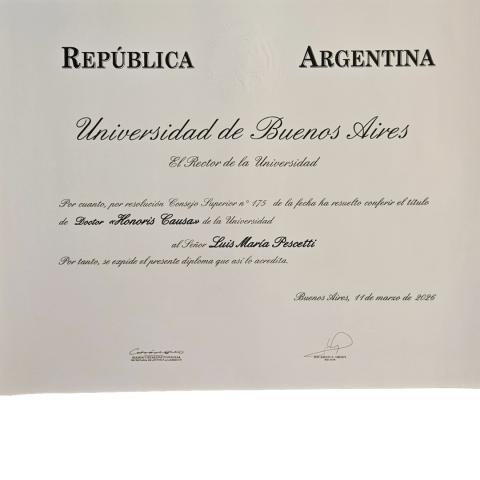
Laughing, master of oneself
By Luis Pescetti
Ceremony for the Conferral of the Degree of Doctor Honoris Causa from the UBA
Luis Pescetti
Rector, Dean, ladies and gentlemen.
I was a teacher who hadn't set out to write comic songs for children, but in one class they called me out: "Teacher, those songs are for little kids." I was stunned — I had more than a hundred songs, the best of the repertoire at the time... and they were the five-year-olds' room.
That's how it started. The day I saw one of them, dazzled by a little classmate who wasn't paying him any attention, I realized my repertoire had no stories with real kids and real families in it. So I wrote the first one — a song where the protagonist wets himself when he sees his girl. That first-person narrator shows there's no shame in losing control for love. The wetting-himself part actually happened to a boy in the four-year-olds' room, whenever he saw me walk into the classroom. Making the narrator the protagonist dilutes the position of power held by whoever's pointing the finger, because he's a peer to whom the same thing happens. That way, the mistake isn't humiliating, and it gets across that "the rules of the court" shouldn't intimidate us.
They answered with a laugh that hasn't stopped to this day.
Once I was stopped at a traffic light, and a mother crossed at the crosswalk with a son of about ten walking ahead, and another of about four, wobbling along on one of those plastic tricycles.
The mother lost her patience and scolded him, yanking him by the arm. Then I watched a big smile spread across the older boy's face. There it is — but if we wrote a song about patience between siblings, we'd lose that moment. Because the older one knew exactly what was expected of him. If we hammer away at the ideal, kids feel the same way we do when we're invited to some little get-together and we can tell it's really a pitch to sell us a timeshare. Better, like in a bolero, not to argue with the feeling: "At last my mom will give him back." And he'd laugh, feeling recognized in his own intelligence. The "siblings must love each other" version has that air of an evangelizing campaign that, deep down, believes "the savages are incorrigible."
It represents a snapshot, and it shouldn't: it should be a film still unfolding.
But when did we learn to see ourselves as a snapshot that doesn't change?
One morning, at a school assembly in Cuernavaca, the sound system stopped working. The principal looked at the microphone, disenchanted, and exclaimed: "Well, that's shot." That expression highlights not the malfunction itself, but the fact that it was expected.
In Latin America, our children grow up hearing about the country's failures, about the corruption of its institutions and officials — always paired with the idea that this is simply "to be expected." Disbelief is baked into the media and into everyday conversation: "It's never going to change," "in another country, this wouldn't happen."
It's a Chernobyl of self-image.
Living in Mexico and working across Latin America reminded me that Argentina was once part of a colony, though we don't think of ourselves that way. Then came a chain of authoritarian regimes, models of dependency; and we lose sight of just how deeply rooted that colonial gaze still is in us. The metropolis administered us, supposedly gracing us with civility and progress, because we natives were undisciplined, ruinous to ourselves.
Later the colony leaves, but the gaze stays behind. If something goes wrong, it doesn't surprise us — we're incorrigible, we're back on "peluda hill" [Argentine slang for being stuck with bad luck]. God is everywhere, but his office hours are in Madrid, which, to make matters worse, isn't even New York, or Paris, or Berlin. And for almost everything, you have to make the pilgrimage to Buenos Aires.
For example, I grew up in San Jorge, along provincial route 13. If the teacher asked for a book, we'd go to a stationery shop that would order it from Santa Fe or Rosario, which brought it in from Buenos Aires. The same went for spare parts, and even radio and television programs, which weren't always broadcast live.
The school inspector arrived in a little Fiat 600. The day before, my mother would wash the school smock and rub chalk on our sneakers to whiten them. The next morning, the silence was absolute — not even the worst-behaved kids in the class moved. The principal would greet her and announce the visit in a stern tone. She'd nod her head, then walk through the classrooms and sit at the back. The teacher's hands would shake as she held her book. And the most extraordinary thing is that we all knew she traveled with a little marmoset monkey in the Fiat, which she left waiting for her in the car with the window cracked slightly open, so it could breathe without roasting in the Santa Fe heat.
There were jokes going around, of course.
People would go out for a stroll around town to look at shop windows, keeping an eye out for anything new — but who was interested in looking at ours?
At the café in the Jockey Club, the lawyers and notaries would gather; not the police chief, but the justice of the peace, yes. Doctors were a category of their own: they wouldn't even take off their white coats to run errands. A "Good morning, Doctor" preceded them wherever they went.
One afternoon I went to a stationery shop to buy school supplies, and the owner handed me some money and said, "Kid, go buy me some cigarettes," and I went. He took that errand for granted, and I took it for granted that I had to carry it out. I was twelve years old.
I grew up dodging forces as if I'd studied postcolonial theory. I knew I had to be liked, I felt ashamed — "don't play the clown," they told me over and over — I watched identity get worn like a borrowed suit, watched myself walk like a stranger on my own soil. Later I left, taking music and comedy elsewhere, which sounds romantic, but is still a displacement, with all the uprooting that implies. In working with children I found my promised land. Read properly, I'm a child who swam until he reached childhood, which is where I found my meaning — the meaning I was hoping for as a kid, and which I'm lucky enough to be able to give back now that I'm grown.
I kept refining my sense of humor: you can laugh not as flattery, and not to go fishing for help with your self-esteem ("I'm a disaster, aren't I?"), but with sovereignty. I confirmed there's a relationship between laughter and territory, and that laughter can be a gesture of identity in the face of so much hierarchy and authoritarianism.
You are honoring me because you've seen your children laugh; I wanted to tell you what's behind that laughter.
I get messages like: "My mom says, how did you know what happens at our house?" Because it happened at mine — I offered my own personal path as an example of just how common this story is.
Especially in days like these, when the defunding of public education, health, science, and technology coincides with the outsourcing of nuclear reactors to foreign companies, going back over the consequences of having been a colony, and the challenge of independence, helps us read what's at stake today.
Just as the University gives us autonomy and critical capacity: Quino, Fontanarrosa, Tato Bores, Les Luthiers, Cortázar, and Borges made us think and laugh, handing our own reality back to us in a familiar language. I learned from them, from my father, who welded a basket onto my bicycle so I could carry bread to the hospital, and from my mother, who woke us up singing, that we have to step away from the litany of failure.
I looked for a laughter of de-exile — one where children recognize themselves in the voice and the anecdotes, where they feel proud of themselves, of the people they love, and of the land they stand on.
I found in laughter the sacred fire that Prometheus stole from the gods to give to humankind.
It breaks the spell, and shows us that the doctor, the authority... they bring a little monkey along in the Fiat; and that the territory has wider horizons than we think.
I feel enormous gratitude toward public education and toward what this University represents.
I cannot imagine a submissive University, or an obedient kind of laughter.
In accepting this honor, I want to remember that, in front of children, we have no right to disillusionment, nor to make them feel like a mistake.
No one deserves what torments them, which is why my characters can make a mistake without themselves becoming one.
When children recognize their own scrapes and adventures, they laugh until they burst with joy, with ravenous curiosity, they steal books from the library, they name their dog after the character, they chase the family around telling them a joke, they play a record until everyone else gets sick of it and complains to me.
That's what it's about — unleashing that whirlwind, not getting in its way — not so that everyone becomes a scientist or a professional, but so that everyone feels like the owner of themselves.
Thank you very much.
August 6, 2026 Ciudad Universitaria, UBA, Buenos Aires
(This text has been translated into English by ChatGPT)