En una era dominada por los vídeos cortos, los algoritmos y el contenido generado por inteligencia artificial en las redes sociales, el humor y la sátira —como formas literarias— se enfrentan a serios desafíos. No obstante, durante tres décadas, el escritor, aforista y editor Dražen Jergović, radicado en Zagreb, ha forjado con firmeza su propio camino creativo, promoviendo obras humorísticas y satíricas tanto en Croacia como en el extranjero.
Profesionalmente, Jergović es ingeniero eléctrico y trabaja en el sector de la protección del medio ambiente; en el ámbito literario, es conocido como autor de obras humorísticas y satíricas, vicepresidente de dos asociaciones literario-artísticas y editor jefe de la revista digital *Uh!Aha*. Sus obras han sido traducidas a trece idiomas y publicadas en numerosos medios nacionales e internacionales. Ejerce como vicepresidente de dos asociaciones literario-artísticas croatas (UHAH y A. Šenoa) y es fundador y editor jefe de la revista digital *Uh!Aha*. Sus aforismos, epigramas, relatos breves, poemas, haikus y ensayos han aparecido en decenas de colecciones y antologías croatas e internacionales. Publica en revistas y portales web —tanto nacionales y regionales como internacionales— dedicados al humor y la sátira, así como a la cultura y las artes. Ha recibido varios premios literarios internacionales, es un promotor global del humor y la sátira, y actúa como embajador cultural de la Fundación Naji Naaman en el Líbano. Está casado y tiene una hija.
En una entrevista con MojZagreb.info, habla sobre sus inicios literarios, la situación de la sátira en la sociedad croata, su trabajo con los jóvenes y el futuro de la expresión creativa.
Para empezar, por favor preséntese ante nuestros lectores. ¿Quién es Dražen Jergović?
Buenos días. Nací en 1980 en Zagreb y crecí entre Zagreb y Sisak. Soy ingeniero eléctrico de profesión; trabajo como diseñador, analista y responsable de control de calidad en una empresa especializada en protección medioambiental. Más allá de mi carrera profesional, llevo más de tres décadas dedicado activamente a la creación literaria, centrándome principalmente en el humor, la sátira y los aforismos. Soy vicepresidente de la Asociación de Aforistas y Humoristas Croatas y de la Asociación de Artistas August Šenoa, y también edito la revista digital "Uh!Aha".
¿Cómo surgió su afición por el humor y la sátira?
Nunca me atrajeron especialmente los chistes clásicos ni el tipo de humor popular accesible para todos, ya que sentía que el idioma croata ofrecía posibilidades mucho más ricas. Empecé a retorcer conceptos y a jugar por mi cuenta con los nombres y apellidos de figuras públicas famosas, creando un efecto cómico o caracterizando a los «héroes» y «heroínas» de estas breves parodias de sus «fechorías» con mi propio estilo único. Para mis compañeros de escuela y para mí, esto era a la vez un juego creativo y una fuente sencilla de diversión y risas interminables. En el proceso, aprendí mucho sobre mi lengua materna y su vasto potencial léxico y semántico; conocimientos que seguí desarrollando en mis escritos a lo largo de los años. Llegué a amar el idioma croata y a mantenerme fiel a él, defendiéndolo frente a la afluencia de préstamos lingüísticos extranjeros, especialmente los anglicismos. Lo que comenzó como mera diversión acabó revelándose como una poderosa herramienta para observar y criticar la sociedad. Mi pasión por la sátira se vio alimentada por los proyectos del ya mencionado grupo de figuras «alternativas», al que yo mismo pertenezco. En cuanto a las influencias extranjeras, destacaría la obra de Benny Hill y *Monty Python’s Flying Circus*. Más cerca de casa, disfrutaba con *Gruntovčani* y con Nela Eržišnik en sus papeles de «Baba Ikača» y «Marica Hrdalo».
¿Qué es lo que más sueles escribir hoy en día?
Actualmente publico mi obra en unos quince medios de comunicación de todo el país y del extranjero, pero mi trampolín fueron revistas y publicaciones de humor y sátira que desaparecieron hace tiempo —como *MaxMinus*, de Bosnia y Herzegovina, y *Žikišon*, de Serbia—, así como la publicación semestral croata *Potepuh* (editada por Dragutin Lončar), que dejó de editarse hace tres años. Todas estas publicaciones se editaban en papel y contaban con cerca de cincuenta colaboradores habituales de la región y de otros lugares. A medida que los patrocinadores retiraban su apoyo, las publicaciones fueron cerrando una tras otra. En la actualidad, escribo una serie de artículos sobre la historia de las revistas de humor croatas. Escribo columnas satíricas o colaboro regularmente en semanarios, revistas mensuales y portales web que siguen apostando por el humor, la sátira, los aforismos y la caricatura: *Hrvatski fokus*, *Diskurs*, *Međimurske novine* y *SB Periskop* (Croacia); *Šipak*, *ETNA*, *NIN* y *Satiraskop* (Serbia); *Koncept* (Bosnia y Herzegovina); *Satirgora* (Montenegro); *Hithi Qesh* (Kosovo); *Balkanium* (Macedonia del Norte); *Fenamizah* (Turquía); y *Humor Sapiens* (Cuba y Chile). Mis aforismos también han aparecido —en una ocasión cada uno— en las revistas búlgaras *Matador* y *Književni svijet*, en el portal eslovaco *Humorikon*, en el archivo alemán de aforismos *DAphA* y en la revista de humor argentina *Entre Guay*. Junto con cuatro colegas de Croacia, he sido incluido en la antología mundial *Reason and Comedy* —publicada en Cracovia (Polonia)—, que recoge las diez mejores citas, aforismos y paradojas de los siglos XX y XXI.
Entre las revistas electrónicas actualmente en activo, destacaría un proyecto de mi colega Ivan Grahovac, de Čakovec: en 2023 lanzó *Apolon*, una publicación trimestral dedicada al humor y la sátira, en la que colaboro habitualmente como articulista, miembro del consejo editorial y corrector de textos. Colaboro con numerosas revistas, portales web y publicaciones, tanto en Croacia como en el extranjero. Mi obra se ha publicado —y sigue publicándose— en Croacia, Serbia, Bosnia y Herzegovina, Montenegro, Kosovo, Macedonia del Norte, Turquía, Cuba y Chile.
Me enorgullece especialmente que mis aforismos, epigramas y textos breves hayan sido traducidos a trece idiomas e incluidos en diversas antologías y recopilaciones internacionales. Esto demuestra que el humor y la sátira —a pesar de las diferencias lingüísticas— pueden llegar al público de todo el mundo.
¿Cuántos libros propios ha publicado?
He publicado cuatro libros. Los dos primeros son recopilaciones de humor y sátira tituladas *Rideamus* y *Ključ (ne)uspjeha* (La clave del [no] éxito). A continuación llegó una novela humorística para jóvenes adultos, *Dnevnik vragolana* (Diario de un travieso), y recientemente se publicó en Serbia mi colección de textos en prosa breve, *Bez prigovora savjesti* (Sin objeción de conciencia).
Cada uno de estos libros representa una etapa concreta de mi vida, que abarca desde la jovialidad y el juego propios de la juventud hasta reflexiones más serias sobre la sociedad y la condición humana.
El primer libro es, en esencia, un almanaque de humor y sátira que incluye casi todas las variedades de «antichistes» y miniaturas satíricas, tales como nombres en rima, grafitis, eslóganes, ocurrencias, anuncios cómicos, parodias de marcas, poemas sarcásticos, versos sin sentido, siglas burlonas y estribillos eróticos. El segundo libro, que marca un alejamiento de la mera frivolidad, ofrece aforismos ingeniosos y reflexiones humorísticas que resultaban relevantes en aquel momento. La novela utiliza un estilo humorístico para narrar las aventuras y desventuras de un adolescente, mientras que la colección de prosa aborda una serie de temas tabú y las dificultades de los protagonistas para desenvolverse ante ellos.
¿Qué formas literarias cultiva con mayor frecuencia?
Escribo en casi todos los géneros —tanto conocidos como desconocidos— de prosa y poesía; incluso he ideado algunos totalmente nuevos. Sin embargo, me siento más cómodo con las formas breves que he presentado a diversos concursos literarios a lo largo de los años. Mis estampas literarias, relatos cortos, poemas de temática romántica y social, así como mis haikus, han aparecido en antologías colectivas en Croacia y la región, mientras que mis aforismos, epigramas y ensayos se han incluido principalmente en antologías y revistas de ámbito regional o internacional.
¿Qué le impulsó a autopublicar sus libros?
Como escritor joven y emergente, deseoso de crear y demostrar mi valía, al principio me sentí motivado por los numerosos concursos literarios disponibles cuando daba mis primeros pasos; algunos de ellos incluso ofrecían premios en metálico. Dado que yo era un desconocido —y que probablemente los jurados no me consideraban lo suficientemente bueno como para figurar en la lista de finalistas—, y siguiendo el consejo de escritores más experimentados que conocí, comprendí que captar la atención de los medios sería más sencillo si contaba con al menos un libro propio publicado. Así fue como surgió *Rideamus*. Por supuesto, como descubrí más tarde, lograr un mayor alcance exigía un esfuerzo adicional en cuanto a promoción, publicidad y organización de encuentros y presentaciones del libro. Sigo teniendo dificultades en este aspecto, ya que el interés por la lectura es escaso; la tecnología ha pasado factura y los libros impresos se están quedando atrás frente a las populares plataformas modernas de expresión personal.
¿Cómo valora el estado del humor y la sátira en Croacia hoy en día?
El panorama mediático se ha comercializado intensamente. Se da prioridad a los contenidos que generan clics y atraen a anunciantes, mientras que la reflexión crítica sobre la sociedad queda relegada a un segundo plano. Por naturaleza, los autores satíricos son personas que cuestionan, analizan y ponen de relieve diversos problemas. No siempre son bien recibidos, ya que a menudo abordan temas que muchos prefieren evitar.
Creo que existe una especie de censura moderna. No es una censura formal, sino que se manifiesta al ignorar aquellos contenidos que no se alinean con los intereses dominantes.
En la década de 1990, con el surgimiento de la independencia de Croacia, parecía que la Guerra de la Patria —y el sufrimiento humano que conllevó— habían extinguido el espíritu alegre y la disposición para el humor que antaño nos caracterizaban. Ya antes de eso, las revistas de humor habían empezado a desaparecer de los quioscos; se retiraron de la programación los programas de televisión con sketches cómicos y los espacios radiofónicos de aforismos; y, en la prensa diaria, las columnas satíricas e incluso las viñetas fueron eliminadas una a una. Fueron sustituidas por secciones de pasatiempos, dejando espacio únicamente para algún chiste popular ocasional o curiosidades internacionales. Las celebridades cobraron cada vez más protagonismo, llegando a ocupar páginas enteras con sus anuncios y promociones. Impulsados por la necesidad de supervivencia, los medios se comercializaron progresivamente, destinando sus espacios a quienes disponían de recursos económicos para compensar la caída en la difusión y las ventas. Así, el capitalismo se infiltró silenciosamente en la opinión pública, fomentando el sensacionalismo y sofocando al mismo tiempo el libre pensamiento que no se alineaba con las estructuras políticas dominantes. Se alimentaba a los lectores con literatura de baja calidad y entretenimiento barato, como si existiera una intención subyacente de embotar los sentidos del público y transformar a la población en una masa obediente y carente de opiniones propias. Lamentablemente, este esfuerzo tuvo gran éxito. En consecuencia, los pensadores independientes no despiertan interés en los medios de comunicación, ya que poseen una gran habilidad para diseccionar la sociedad croata y sus múltiples problemas. Los autores de aforismos y sátiras pertenecen a este mismo grupo de pensadores independientes; se les considera figuras incómodas y sus obras publicadas a menudo terminan en la basura. Así pues, a pesar de la democracia que invocamos constantemente, persiste una forma de censura. El único recurso que les queda a los autores es recurrir a organizaciones —como la Sociedad Croata de Caricaturistas o la Asociación de Aforistas y Humoristas Croatas— o a portales web independientes para poner de relieve los males sociales y criticar cuestiones que preocupan a la mayoría, pero que la gente no se atreve a reconocer. Huelga decir que los humoristas y satíricos renunciaron hace mucho tiempo a recibir remuneración alguna por su trabajo.
Fue en este contexto donde usted fundó la Asociación de Aforistas y Humoristas Croatas. ¿Cuáles son sus objetivos?
El objetivo de la asociación es la preservación y el desarrollo del aforismo, el humor y la sátira en Croacia. Buscamos conectar a autores, publicar libros y antologías, organizar concursos y animar a los jóvenes a iniciarse en la escritura.
Hemos publicado antologías conjuntas que incluyen a aforistas de la región y de Europa, hemos lanzado varios concursos literarios y hemos participado en proyectos internacionales.
Soy miembro de la Asociación de Aforistas y Humoristas Croatas (UHAH) desde su fundación a finales de 2017 y formo parte del grupo de unos veinte cofundadores. Me uní a ella por invitación de los maestros del aforismo croata: los ya fallecidos Tomislav Supek, Josip Balaški, Ivo Mijo Andrić, Jandre Drmić y Miroslav Vukmanić. Como miembro algo más joven y dinámico, se me encomendó —con la ayuda de colegas de mayor experiencia— la tarea de lanzar nuestra propia publicación, crear el sitio web de la asociación y, en general, promover el humor, la sátira y los aforismos. Mi labor también incluía animar a los jóvenes a escribir y participar en proyectos conjuntos, así como impulsar concursos y eventos dedicados al humor y la sátira; concretamente, jornadas en honor a los célebres creadores de estas complejas formas literarias, como aforismos, epigramas, máximas, sentencias, *causeries* y géneros afines. Entretanto, hemos logrado la mayoría de estos objetivos y fomentado numerosas colaboraciones, tanto a nivel nacional como internacional; son logros de los que nos sentimos enormemente orgullosos. Además de la UHAH, soy miembro de la Asociación de Artistas August Šenoa de Zagreb; dado que dicho grupo reúne principalmente a escritores y artistas visuales de mayor edad, mi contribución se centra sobre todo en brindarles apoyo técnico.
¿Cuál es la actividad de su asociación? ¿Cuántos miembros tienen y dónde operan?
Como ya he mencionado, los objetivos más importantes de la asociación UHAH son fomentar la creatividad humorística, satírica y aforística; conectar asociaciones profesionales afines tanto en el país como en el extranjero; publicar obras que incluyan humor, sátira y aforismos; y animar a nuevos y jóvenes talentos a probar suerte y seguir cultivando el espíritu alegre de la nación. Actualmente, la asociación UHAH cuenta con algo más de un centenar de miembros, de los cuales solo un tercio está activo en el ámbito del humor y la sátira; este hecho, junto con la edad media de los integrantes, es motivo de preocupación. Nos sentimos sumamente orgullosos de los anuarios publicados con aforismos de nuestros miembros, de la cooperación internacional y de las antologías conjuntas que hemos editado reuniendo a aforistas croatas con colegas de Bosnia-Herzegovina, Macedonia, Montenegro, Serbia, Eslovenia, Ucrania, la República Checa, Eslovaquia y Polonia; asimismo, este año planeamos proyectos similares con los mejores aforistas búlgaros y alemanes. Los experimentados maestros del aforismo Ivo Mijo Andrić, Zlatko Tomić, Mladen Vuković y Miroslav Vukmanić han sido quienes más han contribuido a estos proyectos. También podemos presumir del primer audiolibro de aforismos, publicado recientemente en la plataforma "book&zvook". Dado que todavía no existe en Croacia un festival temático dedicado al humor y la sátira, varios de nuestros miembros participan habitualmente en veladas festivas y exposiciones de caricaturas a nivel local —donde leen textos humorísticos— o atienden las invitaciones de organizadores para participar en eventos de sátira y humor en países vecinos. Se celebran dos eventos de este tipo en Bosnia-Herzegovina, otros dos en Montenegro y otros dos en Macedonia del Norte, mientras que en Serbia tienen lugar aún más. Lamentablemente, estamos lejos de alcanzar ese nivel de organización o cobertura mediática; no obstante, trabajamos arduamente y logramos salir adelante sin financiación externa. Nos esforzamos por apoyar a la mayoría de nuestros miembros en las presentaciones de sus libros y promocionamos nuestras antologías conjuntas siempre que surge la oportunidad, una labor facilitada por la colaboración de diversas asociaciones y bibliotecas, especialmente en Zagreb y Split.
¿Ya cuenta con proyectos propios o colaborativos finalizados?
Hemos fomentado colaboraciones de gran éxito con aforistas y sus asociaciones en toda la región, así como alianzas individuales con antólogos internacionales —editores o recopiladores de obras aforísticas de todo el mundo— que están elaborando antologías multinacionales. Esta experiencia y este apoyo son inestimables para nosotros y garantizan que este género literario, que plantea grandes desafíos, no desaparecerá a corto plazo. Además de las antologías colaborativas de aforismos, hemos organizado varios concursos —como el premio al mejor libro de humor o sátira del año, el galardón al mejor aforismo en el Festival Internacional de Caricatura de Solin y el concurso al pie de foto breve más divertido para una caricatura de un autor ya fallecido—; todos ellos tuvieron un alcance internacional y suscitaron una gran respuesta por parte de los autores. Personalmente, me complace enormemente la inclusión de varios autores en revistas internacionales de humor y caricatura, así como la difusión de aforismos y humor croatas en semanarios nacionales, publicaciones periódicas literarias y culturales, y portales web internacionales.
El año pasado, por iniciativa propia, lancé una columna titulada «Aforistas croatas» en *Hrvatski Glas Berlin* —una publicación dirigida a la diáspora croata en Alemania— con el fin de dar a conocer a los mejores escritores nacionales de agudezas breves y aforismos. Para los satiristas croatas, lograr abrirse camino en Europa Occidental y Septentrional supondría un avance significativo; sin embargo, la comprensión del idioma y los estilos de escritura plantean ciertos obstáculos. Por ejemplo, la Sociedad Finlandesa de Aforismos valora muy positivamente aquellos aforismos que, desde nuestra perspectiva, se asemejan a los haikus. La razón reside en que las sociedades bien organizadas —a diferencia de la nuestra— se sienten satisfechas con su situación dentro de un Estado que fomenta el crecimiento, el desarrollo y la libertad de expresión y de escritura. En consecuencia, su sátira es considerablemente más suave; no nace de la ira o la envidia del autor, sino de la observación de un mundo idílico. ¿Hace falta mencionar siquiera el tipo de humor que cultivan suizos, neerlandeses o alemanes? Quizás por falta de inspiración, a menudo basan sus aforismos en las obras históricas de Schopenhauer, Nietzsche y Goethe. Nosotros, en cambio, vivimos una realidad cotidiana poco envidiable y sentimos la necesidad de afrontar —aquí y ahora— aquello que nos irrita, nos preocupa, nos agota y nos impide dormir tranquilos. A los occidentales les resulta difícil comprender esto.
¿Pueden los jóvenes de hoy interesarse por el humor y la sátira?
Es posible, pero requiere un trabajo constante. A través de talleres, concursos y colaboraciones con escuelas, veo que existe interés. El problema es que los jóvenes rara vez entran en contacto con este tipo de contenidos.
Hace dos años organizamos un concurso titulado «Seré una estrella: seré humorista», que atrajo a unos setenta estudiantes de toda Croacia. Esto demuestra que el potencial existe.
Si se les ofrece a los jóvenes un espacio para expresarse y se les hace ver que su voz importa, se involucrarán.
Diriges la revista digital «Uh!Aha». ¿Cómo surgió ese proyecto?
Surgió de la necesidad de ofrecer una plataforma de publicación a autores de humor y sátira. Hoy en día, la revista lleva más de seis años publicándose y reúne a colaboradores tanto de Croacia como del extranjero.
Publicamos aforismos, escenas humorísticas, caricaturas, poemas satíricos, anagramas, palíndromos, epigramas y otras formas literarias que rara vez se encuentran en los medios convencionales.
Para nosotros es especialmente importante brindar oportunidades a los autores jóvenes y a aquellos que están comenzando en el mundo de la literatura.
El año pasado fue nominado al premio internacional «Humor Sapiens» en Chile. ¿Qué significó eso para usted?
Fue un gran honor. Ya había colaborado con revistas extranjeras anteriormente, pero esa nominación me abrió nuevas puertas.
Lo más valioso fue conocer a autores de diferentes países y apreciar la diversidad de enfoques sobre el humor. En las sociedades con estructuras sociales estables, la sátira suele ser mucho más suave, ya que la gente no siente la misma necesidad de reaccionar ante los problemas cotidianos que nosotros aquí.
Aquí, la sátira nace a menudo de la frustración, la insatisfacción y la necesidad de denunciar las injusticias. En muchos países occidentales, el humor cumple una función diferente.
¿Qué es lo que, personalmente, te hace reír de verdad?
Me divierten las reacciones espontáneas y naturales ante una provocación, una situación insólita, un giro inesperado o una anécdota —ya sea en el tranvía, en la calle o en el trabajo—, así como una expresión facial graciosa, una exclamación repentina, etcétera. No soy exigente; lo más importante es que quienes me rodean estén de buen humor, no reaccionen de forma negativa o dura ante una broma ligera y sepan aceptar una broma o una crítica dirigida a ellos mismos con la misma naturalidad que una dirigida a los demás. La espontaneidad, la paciencia y el buen humor son difíciles de aprender; por eso hay que cultivarlos y enriquecerlos constantemente con buenas vibraciones y positividad.
Lamentablemente, todas las publicaciones impresas de humor y sátira en Croacia han cesado sus actividades. La más longeva fue la ya mencionada *Potepuh*, que cerró tras su número 48, lanzado para la temporada de carnaval de 2023. Entre las publicaciones de temática humorística, las únicas que permanecen activas son *Apolon*; *Karika* (el boletín de la Asociación de Caricaturistas Croatas, que se publica ininterrumpidamente desde hace 85 años); y la revista *Uh!Aha* —que ahora tiene una periodicidad bimestral—, una publicación digital dedicada al humor, la sátira, los aforismos y las caricaturas, producida por la Asociación de Aforistas y Humoristas Croatas.
Hoy en día, el humor rápido e «instantáneo» —que se consume en un segundo o dos y se olvida con la misma rapidez— goza de una popularidad creciente. El contenido más entretenido consiste en videoclips breves que ofrecen consejos —a menudo absurdos— sobre moda, belleza, pequeñas reparaciones o cocina, junto con acrobacias de atletas aficionados (frecuentemente generadas por inteligencia artificial) e imágenes de belleza retocadas digitalmente. La tecnología moderna y las redes sociales han pasado factura; como resultado, al escritor y al caricaturista tradicionales de humor y sátira solo les queda la modesta satisfacción de recibir «me gusta» por su trabajo, o bien la publicación en contadas revistas y portales web que no ofrecen remuneración alguna, una situación verdaderamente absurda. Mientras tanto, la robótica, la industria automotriz y los videojuegos prosperan, generando enormes sumas de dinero que no llegan a otros artistas y profesionales creativos. Entre los humoristas, los comediantes de *stand-up* son los únicos que logran sobrevivir hasta cierto punto; su habilidad para la sátira escrita ha evolucionado en los últimos años hacia una actuación hablada —e incluso escenificada—, lo que genera una impresión más completa en el público y fomenta una conexión más fuerte. La lectura —y la reflexión que esta conlleva— es la tarea más ardua, razón principal por la cual el humor y la sátira escritos en Croacia permanecen relegados a un segundo plano.
Hace unos años, también realizó una encuesta sobre la presencia del humor en los medios de comunicación y la elección del nombre para la revista. ¿Qué descubrió?
Así es. Al preparar la nueva revista de humor y sátira, me guié en cierta medida por las preferencias de los encuestados. De este modo surgieron algunas de las secciones habituales de la publicación mensual digital *Uh!Aha*; el nombre en sí es esencialmente una combinación de opuestos —un suspiro de desesperación y un suspiro de alivio— y, al mismo tiempo, deriva de las siglas de la asociación. Se encuestó a un total de 90 personas, tanto hombres como mujeres de entre 19 y 65 años, provenientes de diversas profesiones y niveles educativos. La encuesta constaba de 10 preguntas: nueve se centraban en el enfoque del humor y la sátira y en los hábitos de los encuestados, mientras que la última solicitaba la edad del participante. Los resultados fueron los siguientes: el 77,78 % afirmó que en Croacia falta al menos una revista de humor y sátira de alta calidad; el 40 % dijo que la leería o compraría regularmente; el 46 % prefirió una edición impresa frente al 43 % que optó por la digital; y el 39 % se inclinó por un formato semanal, en comparación con el 44,5 % que prefirió uno mensual. Un tercio de los encuestados declaró dedicarse a escribir o dibujar en su tiempo libre, y el 87 % considera útiles los talleres creativos para expresar su talento. Los encuestados mostraron una probabilidad similar de divertirse genuinamente con situaciones cotidianas, chistes, programas de televisión humorísticos o espectáculos de monólogos (alrededor del 20 % en cada caso), mientras que las caricaturas solo entretenían al 8 % de los participantes. Hasta un tercio de los encuestados estaría dispuesto a colaborar en una revista de humor, eligiendo «LAPSUS», «BRUKA» y «VIBRA» como los nombres más llamativos y preferidos para la publicación. Los miembros con más experiencia de la asociación seleccionaron «ZRCALO» por mayoría de votos.
¿Realmente escribe y lee la gente textos humorísticos hoy en día, dado el estado del país?
Los escritos humorísticos y satíricos gozan de gran popularidad en países en transición —o en aquellos que han sido saqueados o devastados—, donde la gente lucha por sobrevivir y se muestra mayoritariamente insatisfecha con las decisiones gubernamentales, los impuestos y las tasas, los bajos salarios y las condiciones laborales, así como con el estado de la educación, la sanidad y la cultura. Para ellos (y para nosotros), estos escritos actúan como una válvula de escape vital —al igual que los logros deportivos—, permitiendo a las personas olvidar por un instante la dura realidad cotidiana. Son precisamente estas acuciantes cuestiones de la vida real las que estimulan la creatividad e impulsan a los autores a criticar el mundo que nos rodea. La ira y la desesperación a menudo dan lugar a brillantes aforistas y satíricos. En la asociación UHAH nos sentimos orgullosos de nuestros miembros, cuyos notables logros han cosechado un reconocimiento significativo, especialmente más allá de nuestras fronteras. Es una lástima que este talento literario excepcional y esta inteligencia innata pasen desapercibidos para la comunidad profesional nacional.
¿Cómo ve a la llamada «competencia», es decir, a quienes trabajan en su mismo ámbito?
La competencia es saludable en cualquier profesión; aquellos que tienen más éxito que nosotros sirven como una gran fuente de motivación e inspiración para nuestros propios proyectos creativos. Aspiramos a alcanzarles en los próximos años y, con un poco de viento a favor y el apoyo de los colegas, creo que incluso podríamos llegar a superarles. Ya veremos.
El año pasado te convertiste en un promotor mundial del humor gracias a tu nominación al premio "Humor Sapiens" en Chile. ¿Hasta qué punto este logro ha abierto oportunidades para la colaboración internacional?
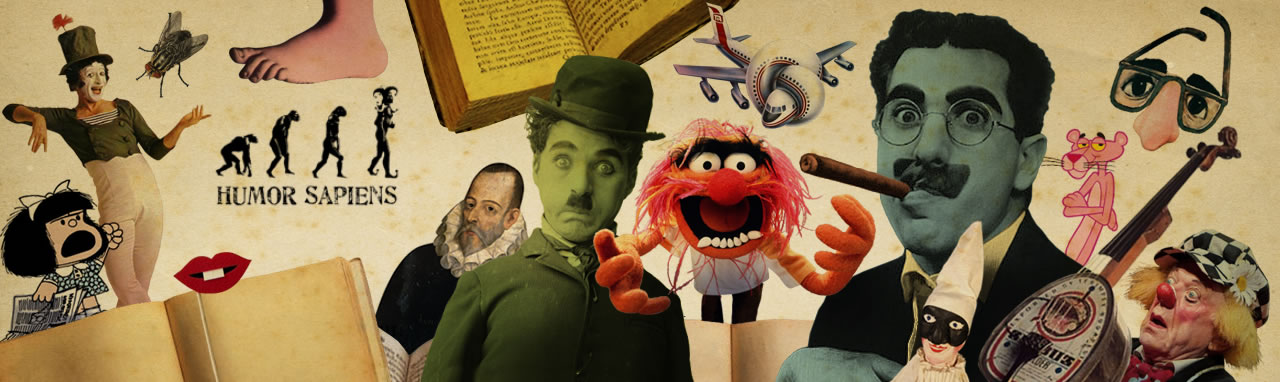
Ya había iniciado colaboraciones con equipos editoriales extranjeros de revistas y sitios web dedicados al humor y la sátira antes de esa importante nominación y de llegar a la final; sin embargo, reconozco que esta experiencia me abrió nuevas puertas y me impulsó a participar aún más activamente. Ver mi nombre asociado a ello me hace sentir, por un momento, como una estrella emergente; tal vez se deba al encantador logotipo que representa a la raza humana regresando gradualmente a sus raíces, una especie de evolución inversa. Y la inversión, la ambigüedad y la paradoja son los rasgos fundamentales de un buen aforismo. Mientras navegaba por la vasta red, encontré varios sitios especializados en caricatura —un género que cuenta con el mayor número de concursos en todo el mundo—, pero también di con las direcciones de correo electrónico de diversas revistas de humor. Tomé la iniciativa de contactar con ellas y envié una colección de aforismos traducidos al inglés, junto con una breve biografía. Los publicaron, lo que supone un éxito personal a la hora de abrirme camino en el panorama internacional del humor. También animo a mis colegas a escribir y ponerse en contacto con los equipos editoriales de revistas y sitios web dedicados al humor y la caricatura, promoviendo así la sátira croata en el escenario mundial.
¿De qué premios se siente especialmente orgulloso y por qué?
Cada premio sirve como prueba de que lo que uno hace tiene sentido: de que alguien sigue tu trabajo y lo valora. No podría destacar uno solo, pero un reconocimiento nacional obtenido en un concurso regional —centrado en la participación comunitaria de los jóvenes y en el fomento de la creatividad mediante talleres educativos y creativos en escuelas— sobresale como una verdadera inversión en el futuro. En cuanto a los galardones profesionales, me complacen especialmente los premios de aforismos recibidos en la categoría para autores experimentados, a pesar de que, por naturaleza, me considero más humorista que satírico. Supongo que me he vuelto más serio con el paso de los años. Mi familia diría que ya era hora. Jajaja. También destacaría haber obtenido el segundo puesto a nivel mundial en el concurso al mejor *limerick* en inglés —entre casi seiscientos participantes—, lo cual supone un gran logro si tenemos en cuenta que solo había escrito tres poemas de este tipo (de tono desenfadado y estructura estricta AABBA) en toda mi vida, y que además tuvieron que ser traducidos al inglés. Fui invitado a la ceremonia de entrega de premios en Polonia, donde también asistí brevemente a la Primera Conferencia Internacional sobre Aforismos en calidad de representante de Croacia; esto resultó doblemente beneficioso, ya que establecí contactos valiosos e inspiradores con personas de una docena de países dedicadas al arte del aforismo.
¿Cuáles son sus planes para el futuro?
Me gustaría lanzar un almanaque de humor de bolsillo, inspirado en aquellas publicaciones de antaño que gozaban de tanta popularidad entre los lectores.
Otro proyecto importante es un manual sobre los géneros literarios humorísticos y satíricos, dirigido a alumnos, universitarios, docentes y cualquier persona interesada en la literatura.
También me gustaría que Croacia celebrara su primer festival nacional de humor y sátira, pues considero que un evento de esta índole debería existir desde hace mucho tiempo.
Por último, ¿cuál es su opinión sobre la inteligencia artificial y su impacto en la creatividad?
No oculto mi escepticismo respecto al contenido generado sin una auténtica intervención humana. La inteligencia artificial puede ser una herramienta útil, pero no debe sustituir a la creatividad humana.
¿Qué mensaje transmitiría a las personas que aún desean crear contenido con alma e identidad, sin recurrir a la inteligencia artificial?
Huelga decir que soy un firme detractor del contenido creado de manera «antinatural»; al igual que me desagradan las creaciones artificiales —o las personas artificiales, dicho sea de paso—, de las cuales, lamentablemente, hay cada vez más hoy en día. Hay individuos que se han transformado hasta volverse irreconocibles; este es uno de los temas sobre los que escribo habitualmente, empleando a menudo la ironía para abordar tales fenómenos. Resulta decepcionante que los jóvenes de hoy en día obtengan información no verificada principalmente de las redes sociales, descuidando en gran medida la literatura, tanto la educativa como la recreativa. Las lecturas obligatorias han caído en desuso hace mucho tiempo; el objetivo es simplemente acceder a datos en cuestión de segundos, dejando tiempo para cosas que suelen ser triviales. Tuve la fortuna de crecer junto a mis abuelos, quienes me guiaron por la vida, mientras adquiría experiencias y habilidades con compañeros ingeniosos: vivencias que hoy significan mucho para mí y de las que me siento inmensamente orgulloso. Inventábamos nuestros propios juegos. El escondite, las canicas y el *zgradomet* eran solo algunos de ellos. Muchos de estos juegos conllevaban el riesgo de pinchar pelotas o romper las ventanas de los vecinos. Hoy en día, las pantallas han acabado con la naturaleza táctil de la infancia y han sofocado las emociones.
La diversidad es lo que nos define; sin embargo, los tiempos modernos convierten a las personas en clones desprovistos de ideas y objetivos propios. El éxito se mide por el número de visitas al perfil y por la cuantía neta de los ingresos. En este proceso, se pasan por alto las dimensiones económica y espiritual: un estilo de vida hedonista, caracterizado por un consumo desenfrenado, se ha convertido en un símbolo de estatus, y son los amigos —y no los padres— quienes dictan qué es lo verdaderamente necesario para alcanzar la felicidad. Las aficiones y la creatividad prácticamente han desaparecido; no conozco a ningún joven de mi entorno que escriba, pinte, toque un instrumento o trabaje la madera...
Hace poco observé que, en una nación de economistas, todo el mundo carece de cultura financiera. Y esa es la verdad, una verdad profundamente preocupante. No soy ni el primero ni el único en afirmar que nuestro sistema de valores se ha invertido por completo. El conocimiento adquirido a través de la educación y la experiencia vital es nuestro activo más valioso —algo que nadie puede arrebatarnos— y deberíamos dedicar mucho más esfuerzo del que dedicamos actualmente a preservarlo y ampliarlo. En un ensayo crítico escribí una vez —con un toque de idealismo utópico—: «Cuando los pintores y escritores ocupen un lugar más alto que los futbolistas y nadadores en la lista de deseos de las mujeres jóvenes, sabré que vivo en una sociedad civilizada. ¡Antes no!».
Sé fiel a ti mismo; antes de plantearle una pregunta a la inteligencia artificial, intenta responderla o resolver ese problema matemático por tu cuenta. Descubrirás que, aunque lleva más tiempo, el resultado es finalmente más gratificante porque has puesto en marcha tu mente y has hecho trabajar esas «pequeñas células grises». Aprendamos a leer entre líneas y a pensar de forma crítica sobre el mundo que nos rodea. Creemos —y sintamos orgullo de— obras que nazcan de nuestra propia mentalidad, en lugar de la de otra persona. Una oportunidad para ello es HUMOR.hr, un portal croata único dedicado al buen humor que se lanzó este año. Su creador es el modesto humorista Damir Markulj, amigo y colega mío de la asociación UHAH. Él ideó el concepto y actualmente estamos trabajando en su desarrollo.
Estamos añadiendo contenido nuevo al sitio de forma activa y buscamos colaboradores, así que no dudes en ponerte en contacto con nosotros y enviar tus trabajos e ideas a info@humor.hr. ¡Buena suerte!
Entrevista realizada por: Petar Kolovrat, junio de 2026 para adriapress.hr
Fotografía: Archivo privado de Dražen Jergović
Interview with Dražen Jergović
In an era dominated by short videos, algorithms, and AI-generated content on social media, humor and satire—as literary forms—face serious challenges. Nevertheless, for three decades, writer, aphorist, and editor Dražen Jergović, based in Zagreb, has steadfastly forged his own creative path, promoting humorous and satirical works both in Croatia and abroad.
Professionally, Jergović is an electrical engineer working in the environmental protection sector; in the literary sphere, he is known as an author of humorous and satirical works, vice president of two literary-artistic associations, and editor-in-chief of the digital magazine Uh!Aha. His works have been translated into thirteen languages and published in numerous national and international outlets. He serves as vice president of two Croatian literary-artistic associations (UHAH and A. Šenoa) and is founder and editor-in-chief of the digital magazine Uh!Aha. His aphorisms, epigrams, short stories, poems, haikus, and essays have appeared in dozens of Croatian and international collections and anthologies. He publishes in magazines and web portals—national, regional, and international—dedicated to humor and satire as well as culture and the arts. He has received several international literary awards, is a global promoter of humor and satire, and serves as cultural ambassador for the Naji Naaman Foundation in Lebanon. He is married and has a daughter.
In an interview with MojZagreb.info, he discusses his literary beginnings, the state of satire in Croatian society, his work with young people, and the future of creative expression.
To begin, please introduce yourself to our readers. Who is Dražen Jergović?
Good morning. I was born in 1980 in Zagreb and grew up between Zagreb and Sisak. I'm an electrical engineer by profession; I work as a designer, analyst, and quality control officer at a company specializing in environmental protection. Beyond my professional career, I've been actively engaged in literary creation for more than three decades, focusing mainly on humor, satire, and aphorisms. I'm vice president of the Croatian Association of Aphorists and Humorists and of the August Šenoa Artists' Association, and I also edit the digital magazine "Uh!Aha."
How did your love of humor and satire come about?
I was never particularly drawn to classic jokes or the kind of popular humor accessible to everyone, since I felt the Croatian language offered much richer possibilities. I started twisting concepts and playing on my own with the first and last names of famous public figures, creating a comic effect or characterizing the "heroes" and "heroines" of these brief parodies of their "misdeeds" in my own unique style. For my schoolmates and me, this was both a creative game and a simple source of endless fun and laughter. In the process, I learned a great deal about my mother tongue and its vast lexical and semantic potential—knowledge I continued developing in my writing over the years. I came to love the Croatian language and remained faithful to it, defending it against the influx of foreign loanwords, especially Anglicisms. What began as mere fun ended up revealing itself as a powerful tool for observing and critiquing society. My passion for satire was fueled by the projects of the aforementioned group of "alternative" figures, to which I myself belong. As for foreign influences, I would highlight the work of Benny Hill and Monty Python's Flying Circus. Closer to home, I enjoyed Gruntovčani and Nela Eržišnik in her roles as "Baba Ikača" and "Marica Hrdalo."
What do you write most often nowadays?
I currently publish my work in about fifteen media outlets around the country and abroad, but my launching pad was humor and satire magazines and publications that disappeared long ago—such as MaxMinus from Bosnia and Herzegovina and Žikišon from Serbia—as well as the Croatian biannual Potepuh (edited by Dragutin Lončar), which stopped publishing three years ago. All of these publications came out in print and had around fifty regular contributors from the region and beyond. As sponsors withdrew their support, the publications closed one after another. Currently, I'm writing a series of articles on the history of Croatian humor magazines. I write satirical columns or contribute regularly to weeklies, monthlies, and web portals that still champion humor, satire, aphorisms, and caricature: Hrvatski fokus, Diskurs, Međimurske novine, and SB Periskop (Croatia); Šipak, ETNA, NIN, and Satiraskop (Serbia); Koncept (Bosnia and Herzegovina); Satirgora (Montenegro); Hithi Qesh (Kosovo); Balkanium (North Macedonia); Fenamizah (Turkey); and Humor Sapiens (Cuba and Chile). My aphorisms have also appeared—once each—in the Bulgarian magazines Matador and Književni svijet, on the Slovak portal Humorikon, in the German aphorism archive DAphA, and in the Argentine humor magazine Entre Guay. Along with four colleagues from Croatia, I was included in the world anthology Reason and Comedy—published in Kraków, Poland—which collects the ten best quotes, aphorisms, and paradoxes of the 20th and 21st centuries.
Among the currently active e-magazines, I'd highlight a project by my colleague Ivan Grahovac from Čakovec: in 2023 he launched Apolon, a quarterly publication devoted to humor and satire, where I regularly contribute as a writer, editorial board member, and proofreader. I collaborate with numerous magazines, web portals, and publications, both in Croatia and abroad. My work has been published—and continues to be published—in Croatia, Serbia, Bosnia and Herzegovina, Montenegro, Kosovo, North Macedonia, Turkey, Cuba, and Chile.
I'm especially proud that my aphorisms, epigrams, and short texts have been translated into thirteen languages and included in various international anthologies and collections. This shows that humor and satire—despite linguistic differences—can reach audiences around the world.
How many books of your own have you published?
I've published four books. The first two are collections of humor and satire titled Rideamus and Ključ (ne)uspjeha (The Key to [Non-]Success). Next came a humorous novel for young adults, Dnevnik vragolana (Diary of a Rascal), and recently my collection of short prose texts, Bez prigovora savjesti (Without Objection of Conscience), was published in Serbia.
Each of these books represents a specific stage of my life, ranging from the joviality and playfulness of youth to more serious reflections on society and the human condition.
The first book is essentially an almanac of humor and satire that includes almost every variety of "anti-joke" and satirical miniature, such as rhyming names, graffiti, slogans, one-liners, comic ads, brand parodies, sarcastic poems, nonsense verses, mocking acronyms, and erotic refrains. The second book, marking a departure from mere frivolity, offers witty aphorisms and humorous reflections that were relevant at the time. The novel uses a humorous style to narrate a teenager's adventures and misadventures, while the prose collection tackles a series of taboo subjects and the characters' struggles in facing them.
Which literary forms do you cultivate most often?
I write in almost every genre—known and unknown—of prose and poetry; I've even devised some entirely new ones. Still, I feel most at home with the short forms I've submitted to various literary competitions over the years. My literary sketches, short stories, romantic and social poems, and haikus have appeared in collective anthologies in Croatia and the region, while my aphorisms, epigrams, and essays have mainly been included in regional or international anthologies and magazines.
What led you to self-publish your books?
As a young, up-and-coming writer eager to create and prove my worth, I was initially motivated by the many literary competitions available when I was taking my first steps—some of which even offered cash prizes. Since I was an unknown—and the judges probably didn't consider me good enough to make the shortlist—and following the advice of more experienced writers I met along the way, I realized that catching the media's attention would be easier if I had at least one book of my own published. That's how Rideamus came about. Of course, as I later discovered, achieving greater reach required additional effort in terms of promotion, publicity, and organizing meet-and-greets and book presentations. I still struggle with this, since interest in reading is scarce; technology has taken its toll, and printed books are falling behind popular modern platforms for personal expression.
How would you assess the state of humor and satire in Croatia today?
The media landscape has become intensely commercialized. Priority is given to content that generates clicks and attracts advertisers, while critical reflection on society is pushed to the sidelines. By nature, satirical authors are people who question, analyze, and shine a light on various problems. They aren't always well received, since they often tackle subjects many would rather avoid.
I believe there's a kind of modern censorship at work. It's not formal censorship, but it shows up in the way content that doesn't align with dominant interests simply gets ignored.
In the 1990s, with Croatia's emergence as an independent nation, it seemed the Homeland War—and the human suffering it brought—had snuffed out the cheerful spirit and appetite for humor that once characterized us. Even before that, humor magazines had begun disappearing from newsstands; TV sketch-comedy programs and radio segments devoted to aphorisms were pulled from the schedule; and in daily newspapers, satirical columns and even cartoons were eliminated one by one. They were replaced by puzzle sections, leaving room only for the occasional popular joke or international curiosity. Celebrities took on an increasingly prominent role, coming to fill entire pages with their ads and promotions. Driven by the need to survive, the media grew progressively more commercialized, handing over their space to whoever had the financial resources to offset falling circulation and sales. In this way, capitalism quietly infiltrated public opinion, fueling sensationalism while at the same time stifling free thought that didn't align with the dominant political structures. Readers were fed low-quality literature and cheap entertainment, as if there were an underlying intent to dull the public's senses and turn the population into an obedient mass devoid of its own opinions. Unfortunately, this effort succeeded remarkably well. As a result, independent thinkers hold little interest for the media, since they possess a keen ability to dissect Croatian society and its many problems. Authors of aphorisms and satire belong to this same group of independent thinkers; they're regarded as inconvenient figures, and their published works often end up in the trash. So, despite the democracy we constantly invoke, a form of censorship persists. The only recourse left to these authors is to turn to organizations—such as the Croatian Society of Caricaturists or the Croatian Association of Aphorists and Humorists—or to independent web portals to highlight social ills and criticize issues that concern most people but that people don't dare acknowledge. Needless to say, humorists and satirists gave up long ago on receiving any payment for their work.
It was in this context that you founded the Croatian Association of Aphorists and Humorists. What are its goals?
The association's goal is the preservation and development of the aphorism, humor, and satire in Croatia. We seek to connect authors, publish books and anthologies, organize competitions, and encourage young people to take their first steps in writing.
We've published joint anthologies featuring aphorists from the region and from Europe, launched several literary competitions, and taken part in international projects.
I've been a member of the Croatian Association of Aphorists and Humorists (UHAH) since its founding in late 2017, part of the group of around twenty co-founders. I joined at the invitation of the masters of Croatian aphorism: the now-deceased Tomislav Supek, Josip Balaški, Ivo Mijo Andrić, Jandre Drmić, and Miroslav Vukmanić. As a somewhat younger, more dynamic member, I was entrusted—with help from more experienced colleagues—with launching our own publication, creating the association's website, and generally promoting humor, satire, and aphorisms. My work also included encouraging young people to write and take part in joint projects, as well as pushing forward competitions and events dedicated to humor and satire—specifically, days honoring the celebrated creators of these demanding literary forms, such as aphorisms, epigrams, maxims, sayings, causeries, and related genres. In the meantime, we've achieved most of these goals and fostered numerous collaborations, both nationally and internationally; these are accomplishments we're enormously proud of. Besides UHAH, I'm a member of the August Šenoa Artists' Association of Zagreb; since that group is made up mainly of older writers and visual artists, my contribution there is mostly technical support.
What activities does your association carry out? How many members do you have and where do you operate?
As I've mentioned, UHAH's most important goals are fostering humorous, satirical, and aphoristic creativity; connecting with like-minded professional associations at home and abroad; publishing works of humor, satire, and aphorism; and encouraging new, young talent to try their hand and keep cultivating the nation's cheerful spirit. UHAH currently has just over a hundred members, of whom only about a third are actively engaged in humor and satire—a fact that, together with the members' average age, is a cause for concern. We're especially proud of the yearbooks we've published featuring our members' aphorisms, of our international cooperation, and of the joint anthologies we've edited bringing together Croatian aphorists with colleagues from Bosnia-Herzegovina, Macedonia, Montenegro, Serbia, Slovenia, Ukraine, the Czech Republic, Slovakia, and Poland; this year we're also planning similar projects with leading Bulgarian and German aphorists. The most experienced masters of the aphorism—Ivo Mijo Andrić, Zlatko Tomić, Mladen Vuković, and Miroslav Vukmanić—have contributed the most to these projects. We can also boast the first audiobook of aphorisms, recently released on the "book&zvook" platform. Since Croatia still doesn't have a themed festival dedicated to humor and satire, several of our members regularly take part in local festive evenings and caricature exhibitions—reading humorous texts there—or accept invitations from organizers to attend satire and humor events in neighboring countries. Two such events are held in Bosnia-Herzegovina, another two in Montenegro, and two more in North Macedonia, while in Serbia there are even more. Unfortunately, we're far from reaching that level of organization or media coverage; still, we work hard and manage to get by without outside funding. We try to support most of our members with their book presentations and promote our joint anthologies whenever the opportunity arises, work made easier by cooperation with various associations and libraries, especially in Zagreb and Split.
Do you already have any finished projects of your own, or collaborative ones?
We've fostered highly successful collaborations with aphorists and their associations throughout the region, as well as individual partnerships with international anthologists—editors or compilers of aphoristic works from around the world—who are putting together multinational anthologies. This experience and support are invaluable to us and help ensure that this demanding literary genre won't disappear anytime soon. Besides the collaborative aphorism anthologies, we've organized several competitions—such as the award for best humor or satire book of the year, the prize for best aphorism at the Solin International Caricature Festival, and the contest for the funniest short caption for a caricature by a deceased author—all of which had international reach and drew a strong response from authors. Personally, I take great pleasure in seeing several authors included in international humor and caricature magazines, as well as in the spread of Croatian aphorisms and humor through national weeklies, literary and cultural periodicals, and international web portals.
Last year, on my own initiative, I launched a column called "Croatian Aphorists" in Hrvatski Glas Berlin—a publication aimed at the Croatian diaspora in Germany—with the aim of introducing the best domestic writers of short wit and aphorism to a wider audience. For Croatian satirists, breaking through in Western and Northern Europe would mark significant progress; however, differences in language comprehension and writing style pose certain obstacles. For instance, the Finnish Aphorism Society tends to rate very highly those aphorisms that, from our perspective, resemble haikus. The reason lies in the fact that well-organized societies—unlike ours—feel content with their situation within a state that fosters growth, development, and freedom of expression and writing. As a result, their satire is considerably gentler; it doesn't spring from the author's anger or envy, but from observing an idyllic world. Do I even need to mention the kind of humor the Swiss, Dutch, or Germans cultivate? Perhaps for lack of inspiration, they often base their aphorisms on the historical works of Schopenhauer, Nietzsche, and Goethe. We, on the other hand, live a rather unenviable everyday reality and feel the need to confront—here and now—whatever irritates us, worries us, wears us down, and keeps us from sleeping soundly. Westerners find this hard to understand.
Can today's young people take an interest in humor and satire?
It's possible, but it takes constant work. Through workshops, competitions, and collaborations with schools, I can see there's interest. The problem is that young people rarely come into contact with this kind of content.
Two years ago we organized a competition called "I'll Be a Star: I'll Be a Humorist," which drew about seventy students from all over Croatia. That shows the potential is there.
If young people are given a space to express themselves and shown that their voice matters, they'll get involved.
You run the digital magazine "Uh!Aha." How did that project come about?
It came out of the need to offer a publishing platform to authors of humor and satire. Today the magazine has been running for more than six years and brings together contributors from both Croatia and abroad.
We publish aphorisms, humorous sketches, caricatures, satirical poems, anagrams, palindromes, epigrams, and other literary forms rarely found in mainstream media.
For us, it's especially important to give opportunities to young authors and to those just starting out in the literary world.
Last year you were nominated for the international "Humor Sapiens" award in Chile. What did that mean to you?
It was a great honor. I'd already worked with foreign magazines before, but that nomination opened new doors for me.
What I valued most was getting to know authors from different countries and appreciating the diversity of approaches to humor. In societies with stable social structures, satire tends to be much gentler, since people don't feel the same need to react to everyday problems that we do here.
Here, satire is often born of frustration, dissatisfaction, and the need to call out injustice. In many Western countries, humor serves a different function.
What personally makes you truly laugh?
I'm amused by spontaneous, natural reactions to some provocation, an unusual situation, an unexpected twist, or an anecdote—whether on the tram, in the street, or at work—as well as a funny facial expression, a sudden exclamation, and so on. I'm not demanding; what matters most is that the people around me are in good spirits, don't react negatively or harshly to a light joke, and know how to take a joke or a bit of criticism aimed at themselves with the same ease as one aimed at someone else. Spontaneity, patience, and good humor are hard to learn; that's why they need to be constantly cultivated and enriched with good vibes and positivity.
Unfortunately, every printed humor and satire publication in Croatia has ceased operations. The longest-running was the aforementioned Potepuh, which closed after issue 48, released for the 2023 carnival season. Among humor-themed publications, the only ones still active are Apolon; Karika (the bulletin of the Croatian Caricaturists' Association, published continuously for 85 years); and the magazine Uh!Aha—now on a bimonthly schedule—a digital publication devoted to humor, satire, aphorisms, and caricature, produced by the Croatian Association of Aphorists and Humorists.
Today, fast, "instant" humor—consumed in a second or two and forgotten just as quickly—is growing ever more popular. The most entertaining content consists of short video clips offering tips—often absurd ones—on fashion, beauty, small repairs, or cooking, alongside stunts by amateur athletes (frequently AI-generated) and digitally retouched beauty images. Modern technology and social media have taken their toll; as a result, the traditional humor and satire writer or caricaturist is left with only the modest satisfaction of getting "likes" for their work, or publication in a handful of magazines and web portals that offer no payment at all—a truly absurd situation. Meanwhile, robotics, the auto industry, and video games thrive, generating enormous sums of money that never reach other artists and creative professionals. Among humorists, stand-up comedians are the only ones who manage to survive to some extent; their skill in written satire has, in recent years, evolved into spoken—and even staged—performance, which leaves a fuller impression on audiences and fosters a stronger connection. Reading—and the reflection it requires—is the hardest task of all, which is the main reason why written humor and satire in Croatia remain pushed into the background.
A few years ago, you also conducted a survey on the presence of humor in the media and on choosing a name for the magazine. What did you find out?
That's right. In preparing the new humor and satire magazine, I let myself be guided to some extent by respondents' preferences. That's how some of the regular sections of the monthly digital publication Uh!Aha came about; the name itself is essentially a combination of opposites—a sigh of despair and a sigh of relief—and at the same time derives from the association's initials. A total of 90 people were surveyed, both men and women aged 19 to 65, from various professions and educational backgrounds. The survey had 10 questions: nine focused on attitudes toward humor and satire and on respondents' habits, while the last asked for the participant's age. The results were as follows: 77.78% said Croatia lacks at least one high-quality humor and satire magazine; 40% said they would read or buy it regularly; 46% preferred a print edition versus 43% who chose digital; and 39% leaned toward a weekly format compared to 44.5% who preferred monthly. A third of respondents said they write or draw in their free time, and 87% consider creative workshops useful for expressing their talent. Respondents were about equally likely to genuinely enjoy everyday situations, jokes, humorous TV shows, or stand-up comedy shows (around 20% each), while caricatures only entertained 8% of participants. As many as a third of respondents said they'd be willing to contribute to a humor magazine, choosing "LAPSUS," "BRUKA," and "VIBRA" as the most striking and preferred names for the publication. The association's more experienced members chose "ZRCALO" by majority vote.
Do people really write and read humorous texts today, given the state of the country?
Humorous and satirical writing enjoys great popularity in transitional countries—or in those that have been plundered or devastated—where people struggle to survive and are largely dissatisfied with government decisions, taxes and fees, low wages and working conditions, and the state of education, healthcare, and culture. For them (and for us), such writing acts as a vital release valve—much like sporting achievements—allowing people to forget the harsh daily reality for a moment. It's precisely these pressing real-life issues that spark creativity and drive authors to critique the world around them. Anger and despair often give rise to brilliant aphorists and satirists. At UHAH we're proud of our members, whose remarkable achievements have earned significant recognition, especially beyond our borders. It's a shame that this exceptional literary talent and innate intelligence go unnoticed by the domestic professional community.
How do you view the so-called "competition"—those working in your same field?
Competition is healthy in any profession; those who are more successful than we are serve as a great source of motivation and inspiration for our own creative projects. We aim to catch up with them in the coming years, and with a bit of wind at our backs and support from colleagues, I think we might even manage to surpass them. We'll see.
Last year you became a global promoter of humor thanks to your nomination for the "Humor Sapiens" award in Chile. To what extent has that achievement opened doors for international collaboration?
I'd already begun collaborating with foreign editorial teams at magazines and websites devoted to humor and satire before that important nomination and reaching the finals; still, I'll admit that experience opened new doors for me and pushed me to get even more actively involved. Seeing my name associated with it makes me feel, for a moment, like a rising star; maybe it's because of the charming logo depicting the human race gradually returning to its roots, a kind of reverse evolution. And inversion, ambiguity, and paradox are the fundamental traits of a good aphorism. While browsing the vast web, I came across several sites specializing in caricature—a genre with the largest number of competitions worldwide—but I also found the email addresses of various humor magazines. I took the initiative to contact them and sent a collection of aphorisms translated into English, along with a short bio. They published them, which counts as a personal success in making my way onto the international humor scene. I also encourage my colleagues to write and reach out to the editorial teams of magazines and websites devoted to humor and caricature, promoting Croatian satire on the world stage.
Which awards are you especially proud of, and why?
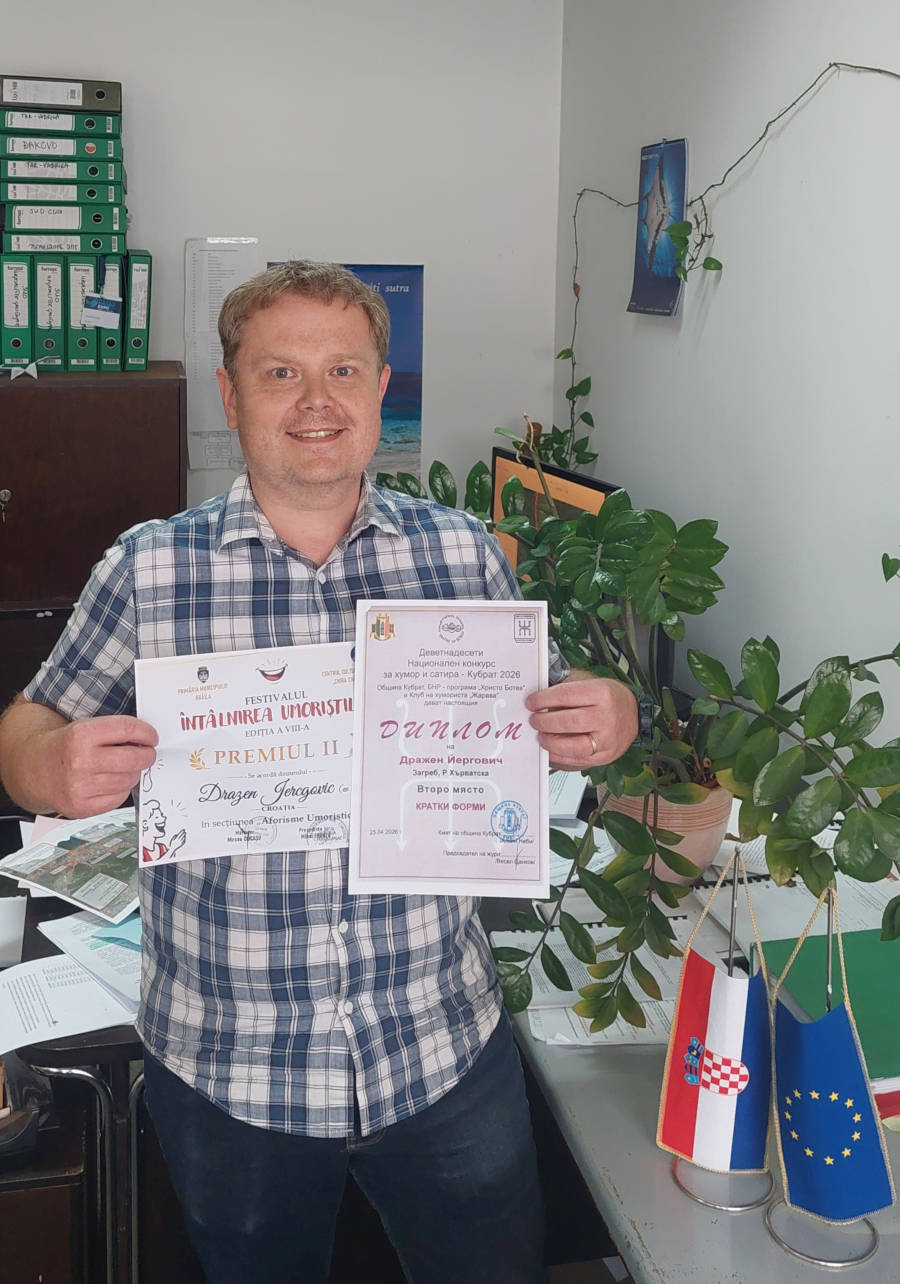
Every award serves as proof that what you do makes sense—that someone is following your work and values it. I couldn't single out just one, but a national recognition earned in a regional competition—focused on community engagement among young people and on fostering creativity through educational and creative workshops in schools—stands out as a real investment in the future. As for professional accolades, I'm especially pleased by the aphorism awards I've received in the category for experienced authors, even though by nature I consider myself more of a humorist than a satirist. I suppose I've grown more serious over the years. My family would say it was about time. Ha ha. I'd also highlight coming in second worldwide in the competition for best English-language limerick—among nearly six hundred participants—which is quite an achievement considering I'd only ever written three poems of that type (lighthearted in tone, with the strict AABBA structure) in my entire life, and they had to be translated into English on top of that. I was invited to the awards ceremony in Poland, where I also briefly attended the First International Conference on Aphorisms as Croatia's representative; that turned out to be doubly rewarding, since I made valuable, inspiring contacts with people from a dozen countries devoted to the art of the aphorism.
What are your plans for the future?
I'd like to launch a pocket-sized humor almanac, inspired by those old publications that were once so popular with readers.
Another important project is a handbook on humorous and satirical literary genres, aimed at students, university students, teachers, and anyone interested in literature.
I'd also love to see Croatia hold its first national humor and satire festival, since I believe an event of this kind is long overdue.
Finally, what's your view on artificial intelligence and its impact on creativity?
I make no secret of my skepticism toward content generated without genuine human involvement. Artificial intelligence can be a useful tool, but it shouldn't replace human creativity.
What message would you give to people who still want to create content with soul and identity, without turning to artificial intelligence?
Needless to say, I'm a firm opponent of content created in an "unnatural" way; just as I dislike artificial creations—or artificial people, for that matter—of which, sadly, there are more and more these days. There are individuals who have transformed themselves beyond recognition; this is one of the subjects I regularly write about, often using irony to address such phenomena. It's disappointing that young people today get most of their unverified information from social media, largely neglecting literature, both educational and recreational. Required reading fell out of fashion long ago; the goal is simply to access data within seconds, leaving time for things that are often trivial. I was fortunate to grow up alongside my grandparents, who guided me through life, while I gained experience and skills alongside clever friends—experiences that mean a great deal to me today and that I'm immensely proud of. We invented our own games. Hide-and-seek, marbles, and zgradomet were just a few of them. Many of these games carried the risk of popping balls or breaking the neighbors' windows. Today, screens have done away with the tactile nature of childhood and have smothered emotions.
Diversity is what defines us; yet modern times turn people into clones stripped of their own ideas and goals. Success is measured by the number of profile views and by net income. In this process, the economic and spiritual dimensions get overlooked: a hedonistic lifestyle marked by unrestrained consumption has become a status symbol, and it's friends—not parents—who now dictate what's truly needed to achieve happiness. Hobbies and creativity have nearly disappeared; I don't know a single young person around me who writes, paints, plays an instrument, or works with wood...
I recently noticed that, in a nation of economists, everyone lacks financial literacy. And that's the truth—a deeply troubling one. I'm neither the first nor the only one to say our value system has been turned completely upside down. Knowledge gained through education and life experience is our most valuable asset—something no one can take from us—and we ought to put far more effort than we currently do into preserving and expanding it. In a critical essay I once wrote—with a touch of utopian idealism—: "When painters and writers rank higher than footballers and swimmers on young women's wish lists, I'll know I'm living in a civilized society. Not before!"
Stay true to yourself; before asking artificial intelligence a question, try answering it or solving that math problem on your own first. You'll find that, although it takes longer, the result is ultimately more rewarding because you've set your mind in motion and put those "little grey cells" to work. Let's learn to read between the lines and think critically about the world around us. Let's create—and take pride in—works that spring from our own mindset, rather than someone else's. One opportunity for that is HUMOR.hr, a unique Croatian portal devoted to good humor that launched this year. Its creator is the unassuming humorist Damir Markulj, a friend and fellow UHAH colleague of mine. He came up with the concept, and we're currently working on developing it further.
We're actively adding new content to the site and looking for contributors, so don't hesitate to get in touch and send us your work and ideas at info@humor.hr. Good luck!
Interview conducted by: Petar Kolovrat, June 2026, for adriapress.hr
Photography: Private archive of Dražen Jergović
(This text has been translated into English by ChatGPT)