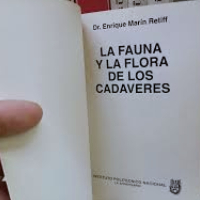
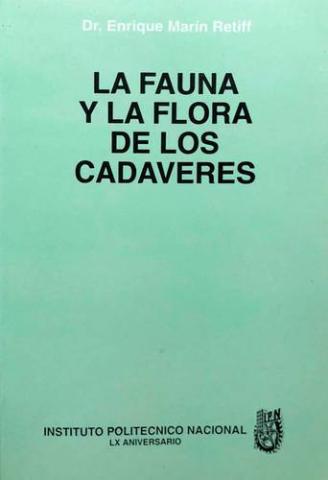
“La fauna y la flora de los cadáveres” del doctor Enrique Marín Retiff (ediciones del Instituto Politécnico Nacional, 1996, México) es una muestra del esfuerzo de instituciones públicas para que, con textos de bajo costo, los alumnos tengan el material de carreras de la institución; así como para que el profesorado de esa institución difunda el resultado de su esfuerzo en la investigación y la cátedra. A 30 años de su publicación, esta edición muestra que el sentido de lo técnico no está peleado con lo filosófico, pero, sobre todo, muestra un Estado mexicano preocupado por la educación, interesado en la difusión de la cultura y el engrandecimiento de las instituciones académicas. Triste contraste de las administraciones recientes, donde se adjetiva peyorativamente a la UNAM o se usan los canales universitarios para hablar de una ideología en el poder, caricaturizando a figuras públicas incómodas a la corriente gobernante (¿o debería decir a los gobernantes corrientes?). En este choque de estados inexistentes, uno por pasado, otro por no
lograr concretarse (salvo en las urnas, otro sofisma universal), el libro de Marín permite que el humor pueda brotar al ojo del buen espectador.
En México se supone que es necesario reírse de la muerte, se hacen calaveras de las dos opciones; una, donde se forman dulces con azúcar en forma de cráneo y otra donde se escriben rimas, generalmente en sonetos octosílabos, para hacer comentarios divertidos sobre algún vivo o algún vival 1 , pero esos días primero y dos de noviembre el que no se ríe de la muerte es porque no es mexicano o no le entra a la intención necrófila. Aunque, ya se verá, no es lo mismo idealizar la muerte que tener un cadáver putrefacto enfrente y menos cuando a uno le da por enterarse de qué tipo de seres vivos aparecen eventualmente en los cuerpos de quienes antes nos abrazaban con amor genuino o a quien antes deseábamos con todo nuestro ser concupiscente, pero que después de poco tiempo resultan un vivero de hongos y un criadero de insectos. Y ese olor, madre mía, es algo que no borra ni Chanel en su mejor presentación.
El tema de la agonía que puede durar de 6 a 18 horas, explica Marín, es una fuente inagotable de humor de mala leche. Si uno supiera que se va a morir, como suelen enterarse los doctores ante el paciente que yace a medio pasillo del hospital popular, el próximo horizontalizado permanente tendría tiempo de hacer las paces con sus familiares o algún otro acto de bondad, pero la verdad es que, entre que al final de la vida uno termina por enseñar el cobre 2 y entre que el mexicano no desaprovecha la oportunidad de hacer broma a costa de los demás, incluso en la parte final de ese peculiar tobogán agónico, todo puede suceder. Mentarles la madre a los parientes 3 , cierto de que no habrá manera de que luego le recriminen (como no sea que le hablen a la lápida), sería lo fácil; el reto es pedir un préstamo bancario mediante alguna aplicación y poner como deudor solidario al pariente que peor le caiga al pseudo difunto; o, mejor aún, hacer una serie de cartas espurias asentando mil y un detalles de cómo el tío Fidencio, respetado hasta por el papa mismo, abusó física, mental y emocionalmente del moribundo, casi hasta llevarlo a las puertas del suicidio. Ya si el moribundo es capaz de usar la IA para hacer fotografías trucadas donde aparezca el falso pedófilo en pleno trance de pasar por la piedra a un niño que tiene la cara desfigurada de algo que no se sabe si es risa histérica por la broma que reventará durante el sepelio del chistoso o un dolor tan profundo que de pronto ese chamaco parece una foto distorsionada de un jugador del mundial al ser dizque golpeado por el defensa del equipo contrario. Quizás, si el tiempo da oportunidad al moribundo achispado, este podría comprar un celular no rastreable y hacer varias amenazas de bomba en hospitales de paralíticos para forzar el desalojo súbito. Y mientras se detecta la llamada de origen, hasta podría ser simpático.
La importancia del saber técnico es que, como se muestra en esta obra, forma parte de lo humano. A estas alturas del partido es una necedad insistir en que el hombre se puede dividir en parcelas de conocimiento como si su mente fuera una ferretería de canaletas independientes. No se puede hablar de las herramientas de lo humano sin entender la interioridad del usuario. Un objeto utilitario solo tiene sentido para quien busca ciertos valores o evidencia la ausencia de estos. Marín muestra su conocimiento sobre hechos derivados de la descomposición física, como lo es la presencia de plantas y animales en la materia descompuesta, pero no oculta su
involuntaria grandeza conceptual en el análisis de las implicaciones profundas, apenas sugeridas en el hecho mismo de que lo humano regrese en la escala evolutiva al volverse animal y hongo, como si cada persona fuera prueba de que venimos del pasado de millones de años y que basta ver las modificaciones corporales derivadas de la invasión de tales seres primero microscópicos y luego de tal tamaño que bien podrían ser servidas en una ensalada alta en proteína y verdura, para entender la futilidad humana. La soberbia de suponerse absolutamente ajeno a las llamadas formas menores de vida también es motivo de risa cuando se le señala al arrogante la manera en que ha cambiado el rostro y el cuerpo de su santa madre apenas unas decenas de horas después
de haber fallecido. Quizás por eso, muchas personas se alejan de los ataúdes abiertos. No desean accionar el mecanismo involuntario que les concientiza que no sólo somos polvo en el viento, también contenedor de la historia evolutiva, y más cuando ese viento se compone de esporas o pupas voraces. Bueno, eso queremos creer que harán todos los que se alejan del féretro pues
también hay los que se ponen a dibujarle cositas al difunto, como pupilas en los párpados cerrados, bigote de Hitler y hasta le abren los labios al cadáver para pintarle de negro un diente frontal de modo que parezca que hay un hueco ahí. El famoso “diente de frijol”, como si la piel de tal alimento pudiera cubrir un diente exactamente. Niégueme que el efecto visual es idéntico. Los
espectadores temerarios son capaces de apretarle las mejillas al rostro mortuorio para dejarlo en un gesto congelado de burla, trompetilla asimilable al sonido flatil o de mostrar toda la dentadura en una sonrisa más cercana a la demencia que al divertimento; ello, aprovechando que en muchos casos rellenan las mejillas de los recién muertos con elementos maleables, generalmente de cera o de plastilina infantil si no hay presupuesto para mejores aditamentos.
La exposición de datos en el libro sobre animales y hongos en los cadáveres va acompañada de una reflexión sobre el sentido de la agonía y de los signos de la muerte. No se requiere ser forense o médico para obtener una lección de filosofía profunda a partir del trabajo del doctor Marín sobre el cuerpo humano residual, pues los cadáveres que menciona en su exposición podrían ser el de cualquiera de nosotros, si es que uno acaba como rata de laboratorio. En México hay leyendas de famosos que se despertaron en el féretro bajo tierra y que al intentar salir se quedaron sin uñas. Con el consiguiente desperdicio de la última manicura, qué se le va a hacer.
Como siempre pasa con el humor, si le sucede a otro podría ser risible, pero si eso le pasa a mi pariente directo, sería un suplicio del que no cualquiera aguantaría bromas al respecto. Es una variante del humor físico. Esto pone a pensar a muchos sobre la pertinencia de ser enterrado o ser cremado; aunque ya puestos a hacer bromas de mal gusto no sé si es preferible reventarse las
uñas contra la tapa interna del ataúd o morir en un último acto de calentura corporal consciente. Los optimistas o los conservacionistas optan por ser enterrados para dejar que la naturaleza haga ese trabajo silencioso de repetir en cada persona, pero en sentido inverso, la peculiar película de la evolución, sintetizando millones de años en unas semanas. Salvo los políticos, la humanidad viene de formas menores molecularmente: los administradores de los fondos públicos siguen siendo formas menores de vida, sobre todo a nivel ético. Aunque muchos de esos oradores suponen que engolar la voz los hace distintos a su condición de delincuente de cuello blanco, basta verles la cara para establecer que tienen el rostro de sus antepasados de especie. Y aquí la metáfora magnífica: todos evolucionamos, pero al morir y empezar a arrojar hongos o pupas de insecto del propio cuerpo humano, estamos involucionando a ojos vista, mientras que esos entes votados involucionan en vida y una vez muertos se liberan de cualquier huésped, pues ni los hongos ni los bichos se sienten capaces de reproducirse en tal podredumbre ético-político-
material.
El flujo mental del autor tiene un tinte mexicano, al hablar de la óptica de la iglesia católica romana en el tema de la cremación. Si en otros países las formas de despedir los cuerpos apenas se cruzan con la voz religiosa, en México no puede eludirse la voz de una institución que durante siglos fungió como registro civil en el recuento de quién moría y quién nacía; y peor porque el imperio español se aventó la puntada de decir que quería expandir la palabra de Dios en la mente de esos habitantes originarios a los que llegó a quitárseles la posibilidad conceptual de tener alma.
La voz de Dios se apilaba en papeles y libros en lugares que sólo hablaban de los muertos y su última residencia. Por extraño que parezca, la chistología mexicana apunta más a la tendencia cural de beber desaforadamente el vino de consagrar, que a su trato con la muerte. No sobra decir que se dice de los religiosos que abusaban (¿todavía? Ahora que entierre a algún pariente practicante, les digo) de los deudos al pedirles dinero de más para las últimas bendiciones, pero parece que no se ve mal, especialmente si estás lavando dinero en las curias donde los párrocos usan coches de alta gama, o usan botas piteadas con anillos de oro con figuras de hoja de marihuana. Si el narco estado mexicano se expone con mayor nitidez en cada acusación trumpiana, a nadie le sorprenderá que a la par o en diagonal se gesten una o varias narco iglesias.
Con eso de que hay miles de registros de asociaciones religiosas, sería cosa de rascarle para encontrar. Suponiendo que quieran dar con esos bienhechores financieros que amablemente hicieron donaciones de efectivo en sobres entregados a parientes directos del candidato de oro verde. Bueno, también se dice que los sacerdotes de antes y de hoy deben ser lectores del Decameron porque repiten los actos concupiscentes con las monjas más a la mano, a veces con el consentimiento de estas, y no hablemos de los menores abusados, porque se acaba la diversión. El problema con los católicos viene de la creencia relativa a que se debe preservar el cuerpo para la resurrección el día del juicio final. Cada vez son más longevas las personas por los adelantos en la medicina, pero también cada vez hay más modificaciones físicas: a finales del milenio pasado cundieron las ampliaciones pectorales femeniles en casi todos los niveles sociales. Si unas usaban gelatinas de nanotecnología para lograr texturas más naturales que lo natural, las posibilidades en el gasto llevaron a otras a levantarse la piel para colocarse bolsas de papas fritas o bolsas ziploc con arena de la playa. Primero muerta que sencilla, dicen algunas. Y en el caso de los hombres también había injertos en los brazos, en los cuadritos abdominales y ni se diga en la cara. Mi amigo del fútbol, con el que jugaba en el kínder, se operó las ojeras, luego los párpados y al final las cejas para lograr ser apodado el Mefistófeles. Apodo que él resiste estoico, sobre todo porque si se ríe se le revientan las costuras y tendría que volver a operarse medio rostro; con lo cual se le notarían los dientes postizos (“a lo Jerry Lewis”, dice mi hijo grande). Entonces, si para los cristianos el cuerpo llevará a la resurrección, cómo será ese cielo donde hombres y mujeres automutilados,vaguen entre las nubes angelicales con huecos en el rostro o en el cuerpo.
La necesidad de mostrar imágenes de los insectos que hacen referencia al tiempo que transcurre en la descomposición, para que el lector aprenda a identificar un bicho de otro, modifican la percepción del aprendiz atento. Ya no sólo son seres pequeños repulsivos por nutrirse con la carne humana, como otros insectos que caminan sobre elementos tóxicos y que parecen divertirse a nuestra costa al gravitarnos durante la ingesta cotidiana, haciendo inútiles los alimentos sobre los que se posan. Y no solo hay moscas, donde todas son de muy mal ver, también hay mariposas llamadas aglosas, que podrían ser golosas y seguro nunca sabrosas. Según el tiempo pueden llegar moscas piofilas, corinetes, loncheas, ofiras y foras (son nombres tan comunes en mi comunidad que no puedo dejar de escribirlas, a ver si algún día puedo leerlas de corrido), todas tan buenas para reproducirse que cuando se exhuma un féretro pueden salir miles de moscas para impactarse contra el rostro o la boca abierta del desenterrador en turno. Son peculiares portadores de la inmortalidad humana en su fase física. Muestran cómo todo se transforma para evidenciar que la
perspectiva del hombre es parcial y equivocada. Al final de nuestras vidas, como individuos y quizás como raza, seremos apenas el alimento que dé continuidad orgánica a un mundo donde los supuestos reyes de la creación seremos sólo un eslabón demasiado pesado para sostenerse en las redes alimenticias globales. Así, esos insectos que nos repelen al verlos o imaginarlos sobre cuerpos en descomposición, se transforman en extraños ángeles que llevan el alma molecular de los restos a otros cielos apenas comprendidos por el hombre pedestre. Y espero que esto último suene bonito porque las descripciones de la putrefacción, la desecación y la momificación en los cuerpecitos humanos enfriados no son para cualquier estómago. Y menos el imaginar a los ácaros redondos y ganchudos que roen, asierran y desmenuzan los tejidos para que el cuerpo tome un color bronceado con olor a cera. De nuevo las lecciones de vida: tanto se cuida la gente de los rayos solares para llegar a la eternidad bien bronceado, pero no por asolearse en la azotea de la vivienda popular ante la imposibilidad de ir a la playa, sino por ser pasto de esas extrañas vacas de
apariencia de insecto. El último comensal es un insecto llamado tenebrio obscurus que devora todo lo que puede, desde restos de insectos hasta la ropa. Si dejan los huesos del cadáver es solo para quedar bien con los vendedores de servicios fúnebres. Claro que esto puede tardar algunos años, pero en la mente de las actuales generaciones bien puede hacerse un reel en cámara rápida
para que no tengan que esperar todo ese tiempo para ver salir a tan lindos bichos de tan poco lindos cadáveres.
Como la filosofía es intrínsecamente poética, el autor matiza el conocimiento profundo con palabras que llevan la lección a niveles literarios al establecer cómo “nuestro presuntuoso ente orgánico” regresa a la nada. La necedad de que somos inmortales a partir de nuestras obras o descendencia es una presunción que se diluye en el tiempo, donde se comprueba lo contrario. Los tiranos o los guías espirituales de hace unos siglos o milenios apenas son recordados hoy. Precisa el autor: “la muerte es una cosa final, definitiva, que salda todas las deudas” para lograr el aprendizaje por contrapunto, pero sin dejar de entender que ante lo orgánico que se pierde de una forma para perpetuarse en otra, es innegable la certeza de que todo pasará, pero desconocemos exactamente cómo o hacia dónde irá. Ante el dolor derivado de la “cobardía ante la perspectiva del póstumo sufrimiento y miedo a lo desconocido e incognoscible de ultratumba,… debemos confortar el corazón con la dulzura de que naufragamos en el océano del infinito”.
------------------------
1 Vival: uso popular para referirse a quien se pasa de vivo, abusa de sus semejantes o vive a costa de los
demás.
2 “Enseñar el cobre”: uso popular para evidenciar de cuan poca categoría moral, cultural, ética o social es
uno, aunque pretenda ser todo lo contrario, de forma inocultablemente falsa.
3 “Mentar la madre”: uso popular para recordar que sólo se sabe quién es la madre, pero no el padre. En
lejana referencia a la violación metafórica y también la real que se dio en la conquista española. Nada más
sagrado para el mexicano que la propia madre, se supone.
Mortuary fauna
By Ricardo Guzmán Wolffer
“The Fauna and Flora of Corpses” by Dr. Enrique Marín Retiff (published by the Instituto Politécnico Nacional, 1996, Mexico) is an example of the effort made by public institutions to ensure that, through low-cost texts, students have the required materials for their degrees at the institution; and also so that the faculty can disseminate the results of their research and teaching. Thirty years after its publication, this edition shows that the technical is not at odds with the philosophical; above all, it reveals a Mexican state concerned with education, interested in spreading culture and strengthening academic institutions. A sad contrast to recent administrations, in which UNAM is pejoratively labeled or university channels are used to promote the ideology of those in power, caricaturing public figures who are inconvenient to the ruling trend (or should I say “the run-of-the-mill rulers”?). In this clash of nonexistent states—one gone, the other never quite materializing (except at the ballot box, another universal sophism)—Marín’s book allows humor to spring forth for the discerning observer.
In Mexico, it is supposedly necessary to laugh at death; there are two “calavera” traditions: one involving sugar skulls, and another consisting of rhymes, usually in octosyllabic sonnets, to make witty remarks about some living person or some upstart [vival]. But on those first and second days of November, anyone who does not laugh at death is either not Mexican or simply unwilling to embrace that necrophilic spirit. Although, as we shall see, it is not the same to idealize death as to have a putrefying corpse in front of you—especially when you start wondering what kinds of living beings eventually appear on the bodies of those who once embraced us with genuine love, or whom we once desired with all our concupiscent being, only to become, after a short time, a fungal nursery and an insect breeding ground. And that smell, good heavens, is something not even Chanel in its finest presentation can erase.
The topic of the death throes, which can last from 6 to 18 hours, Marín explains, is an inexhaustible source of mean-spirited humor. If one knew they were going to die—as doctors often do when faced with a patient lying halfway down the corridor of a public hospital—the next permanently horizontalized individual would have time to make peace with their relatives or perform some other act of kindness. But the truth is, between the fact that at the end of life people tend to show their true colors [enseñar el cobre], and given that Mexicans do not miss the opportunity to joke at others’ expense, even in the final stretch of that peculiar agonizing slide, anything can happen. Insulting the relatives’ mother [mentarles la madre] is the easy option, knowing there will be no way for them to later complain (unless they talk to the tombstone). The real challenge is to apply for a bank loan through some app and list as a co-debtor the relative the pseudo-deceased liked the least; or, even better, to write a series of spurious letters detailing how Uncle Fidencio, respected even by the Pope himself, physically, mentally, and emotionally abused the dying person, almost driving them to the brink of suicide. And if the dying person is capable of using AI to create doctored photographs showing the alleged pedophile in the act of “going over the stone” [pasar por la piedra, i.e., brutally assaulting] a child whose face is so distorted it’s unclear whether it reflects hysterical laughter at the prank that will explode during the joker’s funeral, or such profound pain that the kid looks like a distorted photo of a World Cup player supposedly struck by the opposing team’s defender. Perhaps, if time allows and the dying person is a bit tipsy [achispado], they could buy an untraceable phone and make several bomb threats at hospitals for the paralyzed to force a sudden evacuation. And by the time the source of the call is detected, it might even seem amusing.
The importance of technical knowledge is that, as shown in this work, it is part of what it means to be human. At this stage of the game, it is stubborn to insist that human beings can be divided into parcels of knowledge as if the mind were a hardware store with separate gutters. One cannot speak of the tools of the human without understanding the user’s interiority. A utilitarian object only makes sense to someone who seeks certain values or evidences their absence. Marín displays his knowledge of facts derived from physical decomposition, such as the presence of plants and animals in decomposing matter, but he does not conceal his unintentional conceptual grandeur in analyzing the profound implications, barely suggested by the very fact that the human returns down the evolutionary scale by becoming animal and fungus—as if each person were proof that we come from millions of years in the past, and that it suffices to observe the bodily modifications resulting from the invasion of such beings (first microscopic, then large enough to be served in a high-protein, high-vegetable salad) to understand human futility. The arrogance of supposing ourselves absolutely alien to so-called lower forms of life is also comical when the arrogant are shown how the face and body of their saintly mother have changed merely a few dozen hours after her death. Perhaps that is why many people avoid open caskets: they do not wish to trigger the involuntary mechanism that makes them aware that we are not only dust in the wind, but also containers of evolutionary history—especially when that wind consists of voracious spores or pupae. Well, we like to believe that this is why everyone steps away from the coffin; but there are also those who take to drawing little things on the deceased: pupils on closed eyelids, a Hitler mustache, even prying the corpse’s lips open to paint a front tooth black so it looks like there’s a gap there. The famous “bean tooth” [diente de frijol], as if the skin of such a legume could cover a tooth exactly. Tell me the visual effect isn’t identical. Bold spectators are even capable of squeezing the mortuary cheeks to fix the face in a frozen gesture of mockery: a pout resembling a flatulent sound, or a grin showing all the teeth that looks closer to madness than to amusement—all this taking advantage of the fact that, in many cases, the cheeks of the recently dead are stuffed with malleable materials, usually wax or children’s modeling clay if there’s no budget for better accessories.
The presentation of data in the book on animals and fungi on corpses is accompanied by a reflection on the meaning of agony and the signs of death. One does not need to be a forensic scientist or a doctor to draw a profound philosophy lesson from Dr. Marín’s work on the residual human body, as the corpses mentioned in his exposition could belong to any one of us—assuming one ends up like a laboratory rat. In Mexico, there are legends of celebrities who woke up in their coffins underground and lost their fingernails trying to scratch their way out. Along with the subsequent waste of that last manicure—what can you do?
As is always the case with humor, if it happens to someone else it might be laughable, but if it happens to a direct relative, it would be a torment about which hardly anyone could stomach jokes. It’s a variation of slapstick humor. This leads many to contemplate the wisdom of being buried versus being cremated; though while we’re on the subject of tasteless jokes, I don't know whether it is preferable to split one's nails against the inner lid of the coffin or to die in one final act of conscious bodily heat. Optimists or conservationists choose burial to let nature do that quiet work of repeating—in reverse—the peculiar film of evolution for each person, condensing millions of years into a few weeks. Except for politicians, humanity stems from molecularly lesser forms: administrators of public funds remain lesser life forms, especially on an ethical level. Although many of those orators assume that projecting their voices sets them apart from their status as white-collar criminals, one need only look at their faces to determine that they bear the features of their species' ancestors. And here lies the magnificent metaphor: we all evolve, but upon dying and beginning to shed fungi or insect pupae from our own human bodies, we are visibly devolving, whereas those elected entities devolve while still alive and, once dead, are freed from any host, as neither fungi nor bugs feel capable of reproducing in such ethical, political, and material rot.
The author’s mental flow carries a Mexican nuance when speaking of the Roman Catholic Church's perspective on cremation. If in other countries the ways of saying goodbye to bodies barely intersect with religious authority, in Mexico one cannot evade the voice of an institution that for centuries acted as the civil registry accounting for who died and who was born. It’s all the worse because the Spanish Empire had the nerve to claim it wanted to spread the word of God in the minds of those native inhabitants—who ended up being stripped of even the conceptual possibility of possessing a soul.
The voice of God was stacked in papers and books in places that spoke only of the dead and their final residence. Strange as it may seem, Mexican "jokelore"* points more toward the clerical tendency to recklessly gulp down the sacramental wine than to their dealings with death. It goes without saying that clergy members are said to have abused (still? Now that I’m burying a practicing relative, I'll let you know) the bereaved by demanding extra money for final blessings. But this doesn't seem to be looked down upon, especially if you are laundering money in dioceses where parish priests drive luxury cars or wear hand-embroidered leather boots (botas piteadas) adorned with gold rings featuring marijuana leaf designs. If the Mexican narco-state exposes itself with greater clarity in every Trumpian accusation, no one will be surprised if, alongside it or at an angle, one or several narco-churches take root.
Given that there are thousands of registered religious associations, it would just be a matter of digging around to find them. Assuming, of course, that anyone wants to track down those financial benefactors who kindly made cash donations in envelopes handed directly to the relatives of the "green gold" candidate. Well, it is also said that priests, both past and present, must be avid readers of the Decameron, given how they repeat concupiscent acts with the nearest available nuns—sometimes with their consent—and let’s not even mention the abused minors, because that ruins the fun.
The problem for Catholics stems from the belief that the body must be preserved for resurrection on Judgment Day. People are living longer and longer due to medical advances, but physical modifications are also on the rise: toward the end of the last millennium, female breast augmentations proliferated across almost all social levels. While some used nanotech gels to achieve textures more natural than nature itself, spending limits led others to lift their skin to insert bags of potato chips or Ziploc bags filled with beach sand. "Better dead than plain," as some say. As for men, there were also implants in arms, abdominal packs, and especially faces. My childhood soccer buddy from kindergarten had his eye bags done, then his eyelids, and finally his eyebrows, earning himself the nickname Mephistopheles. It's a nickname he endures stoically, mostly because if he laughs, his stitches will pop and he’ll have to get half his face operated on again—which would reveal his false teeth ("à la Jerry Lewis," as my eldest son puts it). So, if for Christians the body leads to resurrection, what will that heaven be like, where self-mutilated men and women wander among angelic clouds with gaping holes in their faces or bodies?
The necessity of displaying images of insects—referencing the timeline of decomposition so the reader learns to distinguish one bug from another—alters the attentive learner's perception. They are no longer merely repulsive little creatures feeding on human flesh, like other insects that walk on toxic waste and seem to mock us by hovering during our daily meals, rendering the food they land on useless. And there aren't just flies—all of which are foul to look at—there are also moths known as Aglossa, which might sound greedy (golosas) but are certainly never tasty (sabrosas). Depending on the timeframe, cheese skipper flies (Piophila), bone beetles (Corynetes), spear-winged flies (Lonchaea), dump flies (Ophyra), and scuttle flies (Phora) may arrive (names so common in my community that I can't help but write them down, hoping that one day I can read them all in one breath). All of them are so adept at reproducing that when a coffin is exhumed, thousands of flies can burst out to slam against the face or open mouth of the gravedigger on duty. They are peculiar carriers of human immortality in its physical phase, demonstrating how everything transforms to prove that man's perspective is partial and mistaken. At the end of our lives, as individuals and perhaps as a species, we will be mere food ensuring the organic continuity of a world where the supposed kings of creation are just a link too heavy to sustain itself within global food webs. Thus, those insects that repel us when we see or imagine them on decaying bodies transform into strange angels carrying the molecular soul of our remains to other heavens barely understood by pedestrian man.
I hope that last part sounded nice, because descriptions of putrefaction, desiccation, and mummification in chilled little human bodies are not for the faint of stomach. Even less so is imagining the round, hooked mites that gnaw, saw, and shred tissues so the body takes on a bronzed color with the scent of wax. Life lessons, once again: people take such great care to shield themselves from the sun's rays just to reach eternity nicely tanned—not by sunbathing on the roof of a working-class home for lack of a beach trip, but by becoming fodder for those strange, insect-like cows. The final diner is a beetle called Tenebrio obscurus, which devours everything it can, from insect remains to clothing. If they leave the corpse's bones behind, it's only to stay on good terms with funeral directors. Of course, this can take a few years, but in the minds of current generations, a fast-forward reel could easily be made so they don't have to wait all that time to watch such cute bugs emerge from such uncute corpses.
Since philosophy is intrinsically poetic, the author softens deep knowledge with words that elevate the lesson to literary heights, establishing how "our presumptuous organic entity" returns to nothingness. The foolish belief that we are immortal through our works or lineage is a conceit that dilutes over time, proving the exact opposite. The tyrants or spiritual guides of a few centuries or millennia ago are barely remembered today. As the author notes: "death is a final, definitive thing that settles all debts," achieving wisdom through counterpoint—yet without failing to grasp that, before the organic material lost in one form to perpetuate itself in another, there remains the undeniable certainty that everything shall pass, though we do not know exactly how or where it will go. Faced with the pain born of "cowardice before the prospect of posthumous suffering and fear of the unknown and unknowable beyond the grave... we must comfort our hearts with the sweetness of shipwrecking in the ocean of the infinite.
------------------------------
-
-
Chistología (translated above as "jokelore"): A wordplay combining chiste (joke) and cristología (christology), referring to jokes made at the expense of religious figures or death.
-
Vival / Pasarse de vivo (Footnote 1 in source): Refers to a street-smart opportunist or someone who takes unfair advantage of others.
-
Enseñar el cobre (Footnote 2 in source): Lit. "to show the copper beneath the gold plating"—to reveal one's true, low moral or ethical character despite pretending otherwise.
-
Mentar la madre (Footnote 3 in source): To insult someone by cursing their mother, deeply rooted in Mexican cultural identity.
-
(This text has been translated into English by ChatGPT)