
Introducción
Nos atrevemos a decir que de todas las modalidades de la literatura el humor es con la que más podemos satisfacernos al escribir, puesto que su mismo carácter contiene un elemento de libertad plena que quizá no se encuentra en otros enfoques. Los textos dramáticos y trágicos precisan de un férreo control sobre la lengua y de una coherencia continua. El humor, por el contrario, puede permitirse la desconexión, el absurdo, la digresión, el cambio de nivel, la mezcla de estilos y cualquier otro recurso que el autor quiera utilizar. Podría decirse que el escritor humorístico puede escribir cualquier cosa: en el peor de los casos, su experimento no tendrá gracia, pero nadie le podrá impedir que trastoque la historia, que deforme la realidad y que haga hablar a las tostadoras o que nos cuente que Napoleón era chino y que nadie lo sospechó nunca.
Para beneficio de esas almas selectas con sentido del humor se ha compilado estos “cien concejos”, que incluye directrices comprobadas para la elaboración de textos cómicos, porque la escritura no precisa únicamente de ideas y de talento: sus técnicas deben aprenderse, como todo en esta vida.
Pero esta compilación no se reduce a la creación escrita, porque hay múltiples formas de hacer humor por otros medios, como pueden ser las viñetas satíricas, los «caprichos» de Goya, los efectos cómicos del cine mudo, la actuación de un payaso funambulista en un circo, la mímica en toda su extensión... Por ello hemos incluido también la explicación y descripción de todo tipo de gags y recursos visuales, algo que no se encontrará en ningún manual de escritura.
Los autores han pretendido modestamente... no, no es cierto. Los autores no son modestos en absoluto, sino dos humoristas de pro que llevan mucho años haciendo reír a sus lectores y que ahora generosamente comparten su experiencia comiquizadora con quien quiera leer estos artículos en cada Boletín Humor Sapiens, o compilados todos en un libro.
CONSEJO 1. Estudiar
El primer consejo —si realmente desea hacer reír a través del humor y lo cómico de forma seria (que no es lo opuesto de humor), responsable— sería estudiar las diferentes teorías del humor, las definiciones de comicidad, comedia, humor, humorismo, risa, sátira, parodia, ironía, sarcasmo, caricatura y un largo etcétera.
Si decidimos publicar estos consejos, es también para mejorarles el camino a los que intentan crear para hacer reír y a los que deseen estudiar —muy someramente—, los conceptos que consideramos fundamentales para entender los fenómenos principales del humor y la comicidad. No pretendemos ser exhaustivos ―lo cual es casi imposible en un terreno tan amplio― ni definitivos ―imposible también en este terreno, donde campean la subjetividad y un amplísimo espectro de criterios y enfoques, a veces demasiado estrechos o acotados y otros tan amplios que resultan difusos.
Lo cual es comprensible en una materia que atañe a la naturaleza del ser humano pero que no comenzó a ser observada, pensada y estudiada de modo sistemático hasta fechas recientes.
Por todo lo anterior, es que aconsejamos profundizar en el campo al que va a dedicarse, ya sea para hacer reír de manera aficionada o profesional, porque estamos convencidos de que para crear o interpretar humor de calidad, es imprescindible hacerlo.
Así que, si ya ha estudiado el humor, perfecto. Sáltese este consejo y espere el próximo Boletín.
Pero si no lo ha estudiado, tiene tres alternativas:
1—Estúdielo antes de leer estos consejos.
2—Estúdielo después de leer estos consejos.
3—Estúdielo mientras lee cada consejo.
¿Otro consejo?
Estúdielo cuando lo estime conveniente y de la forma que entienda le beneficiaría más y mejor, según sus características propias.
Para adquirir el libro “Cien Consejos para hacer reír”, entre aquí.
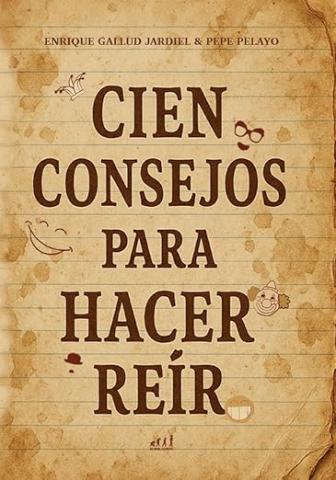
110 tips to make people laugh
By Enrique Gallud Jardiel and Pepe Pelayo
Introduction
It is fair to say that, of all the literary modes, humor is the one that can give us the greatest satisfaction when writing, since its very nature contains an element of total freedom that may not be present in other approaches. Dramatic and tragic texts require iron control over language and unbroken coherence. Humor, on the other hand, can allow itself disconnection, absurdity, digression, shifts in register, the mixing of styles and any other device the author wishes to use. One could say that a humorous writer can write absolutely anything: in the worst‑case scenario the experiment will not be funny, but no one can prevent the writer from upsetting history, distorting reality, making toasters talk or telling us that Napoleon was Chinese and no one ever suspected it.
For the benefit of those select souls blessed with a sense of humor, these “one hundred tips” have been compiled, including tried‑and‑tested guidelines for the creation of comic texts, because writing does not rely solely on ideas and talent; its techniques must be learned, as with everything in life.
This compilation is not limited to written creation, however, because there are many ways of producing humor by other means, such as satirical cartoons, Goya’s Caprichos, the comic effects of silent film, the performance of a tightrope‑walking clown in a circus, mime in all its breadth… For that reason, we have also included the explanation and description of all kinds of gags and visual resources, something you will not find in any ordinary writing manual.
The authors have modestly intended… no, that is not true. The authors are not modest in the least, but rather two seasoned humorists who have been making their readers laugh for many years and who now generously share their joke‑crafting experience with anyone who wishes to read these articles in each issue of Boletín Humor Sapiens or gathered together in a book.
TIP 1. Study
The first tip—if you truly wish to make people laugh through humor and comedy in a serious (which is not the opposite of humorous), responsible way—would be to study the different theories of humor and the definitions of funniness, comedy, humor, humorismo, laughter, satire, parody, irony, sarcasm, caricature and a long etcetera.
If we have decided to publish these tips, it is also in order to make things easier for those who are trying to create in order to make others laugh and for those who wish to study—very briefly—the concepts we regard as fundamental to understanding the main phenomena of humor and comic effect. We do not claim to be exhaustive—which is almost impossible in such a vast field—nor definitive—also impossible in an area where subjectivity reigns and where there is a very broad spectrum of criteria and approaches, sometimes too narrow or constrained and at other times so broad that they become vague.
This is understandable in a subject that concerns human nature, yet did not begin to be observed, considered and studied systematically until quite recently.
For all these reasons, we advise you to delve into the field to which you are going to devote yourself, whether to make people laugh as an amateur or as a professional, because we are convinced that, in order to create or perform quality humor, doing so is essential.
So, if you have already studied humor, perfect. Skip this tip and wait for the next Boletín.
But if you have not studied it, you have three alternatives:
1—Study it before reading these tips.
2—Study it after reading these tips.
3—Study it while you read each tip.
Another tip?
Study it whenever you think best and in the way you feel will benefit you most, according to your own particular characteristics.
To purchase the book One Hundred Tips for Making People Laugh, click here.
(This text has been translated into English by ChatGPT)