[1919–1939]
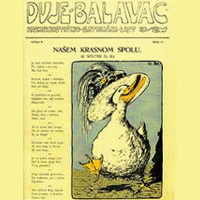
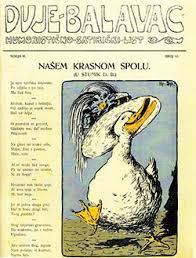
Duje Balavac es la más conocida de las revistas humorístico-satíricas que se publicaron en la región de Dalmacia durante el siglo pasado. Se editó en Split entre 1908 y 1923, bajo la dirección del escritor Ante Katunarić. El primer número apareció el 7 de febrero de 1908 y se publicaba mensualmente, en formato de 32 cm. Estaba ricamente ilustrada y se imprimía en la Imprenta Social de Split. En esta ciudad existe una edición electrónica del año 2009.
En cuanto a contenidos, era muy variada: publicaba noticias, chistes, deportes, caricaturas, anuncios, relatos satíricos, burlas, anécdotas, poemas humorísticos, curiosidades regionales, crítica política y cartas de los lectores. Parte de los textos estaban escritos en dialecto čakaviano (čakavica) y también en lengua italiana. Existía un gran interés por parte de los colaboradores en publicar en esta revista.
El 11 de enero de 1919 comenzó a publicarse el semanario humorístico Golub, al que siguieron otros títulos humorísticos.
Golub fue editado y publicado por el joven periodista, poeta y abogado autodidacta Petar Sabić. Según él mismo escribió en el número 98 de 1924, lo fundó tras regresar del exilio. El primer número apareció, según su testimonio, el 11 de enero de 1919, impreso en papel verde. Para su publicación utilizó la suma de 400 kunas, ayuda económica que había recibido para trasladarse a Bosnia y emplearse en un despacho de abogados. No quedó satisfecho con ese primer número, al que consideraba “demasiado corto” y “débil”.
La revista se publicaba de manera irregular, y el último número apareció en febrero de 1924, poco antes de la muerte de su editor. Golub publicaba poemas humorísticos, epigramas, bromas mordaces y textos breves en los que, a veces con humor y otras con ironía, se burlaba de políticos locales de Split, de ciudadanos conocidos y comentaba acontecimientos políticos de la ciudad. Al principio predominaba un humor de burla directa, pero progresivamente fue imponiéndose la sátira política de carácter local y también nacional, lo que se anunció con el cambio de subtítulo a “semanario político-humorístico” en el número 81 de 1923. Golub contó además con dos suplementos: Snopić y Republikanski golubić.
En Split apareció en 1919 otra revista humorística titulada Žica, cuyo propietario y editor fue Antun Antunović. El título tenía una doble connotación con la que el editor jugaba hábilmente. Aunque el lector podía esperar personajes cómicos y relatos curiosos, predominaba un humor básico de temática local. Debido a este carácter, poco apreciado por la mayoría de los lectores, la revista dejó de publicarse tras solo tres números (el último apareció el 14 de agosto de 1919), por razones desconocidas.
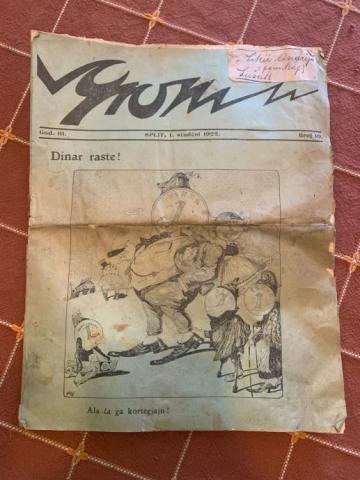
Grom fue una revista humorística ilustrada dirigida por Marko Uvodić, publicada en Split cada dos sábados entre el 4 de septiembre de 1920 y el 12 de marzo de 1922, en formato 24 × 32 cm, impresa en la Imprenta Nacional. Constaba de cuatro páginas de texto sin caricaturas, con un logotipo a una sola cara en la portada, aunque los tres primeros números se publicaron con seis páginas. Contenía noticias y anuncios escritos en tono satírico. El editor fue Ljubo Prijatelj y el principal colaborador, Marko Uvodić (Zelembać). Desde 1921, Uvodić pasó a ser propietario y editor responsable.
Grom fue una revista muy popular, con una amplia tirada y difusión también fuera de Split. En 1921 se imprimieron 7.000 ejemplares, de los cuales 1.800 se distribuyeron por la entonces Yugoslavia.
La impresión se volvió cada vez más costosa y los suscriptores ignoraban los llamados de la redacción para pagar la suscripción. A pesar del aumento del espacio publicitario, la revista sufría constantes problemas económicos. Dejó de publicarse a finales de 1922, probablemente por estas razones. En sus textos, Uvodić reaccionaba humorística y satíricamente a sucesos de la riva, la plaza, el mercado, el café, el campo de fútbol y, en general, a múltiples acontecimientos y fenómenos de la vida pública.
(Fuente: Z. Mužinić, p. 37, 1978)
Električne stranice fue otra revista humorística aparecida en Split en 1920. Publicaba chistes ingeniosos y anécdotas sobre escritores internacionales, así como comentarios sobre acontecimientos culturales mundiales. Dejó de publicarse tras nueve números.
Un año después apareció Mošun, una revista humorística dedicada a los llamados šotokuci de Split (intrigantes discretos y bromistas). Su editor responsable fue Ljubo Petrić. Publicaba chistes y comentarios ingeniosos sobre la vida urbana y localidades cercanas, destacando la sección “Ča kome fali” (“Qué le falta a alguien”), muy popular en la prensa humorística local. En ella se recogían pensamientos aforísticos que revelaban deseos y defectos públicos y privados de diversas personas, especialmente políticos locales.
“To su moji posli…” fue el título de una revista humorística publicada en 1923, de la que solo aparecieron dos números. Coincidió con el período electoral y contenía sátiras, chistes y aforismos sobre el ambiente político previo a las elecciones. En Split se publicaron también Na (1923-1924), dirigida por Vijo Krstulović, y Ricinus, de Nike J. Bužančić (1925).
Debe añadirse Spliski krnjeval, revista publicada con motivo del carnaval en 1927, en solo dos números. Fue el primer periódico editado específicamente para el carnaval. El editor fue el Comité para el Turismo, y los responsables editoriales Ante Katunarić y Marko Uvodić. La revista reflejaba un ambiente carnavalesco festivo y estaba gráficamente enriquecida con caricaturas y escenas típicas del carnaval.
Ante Ružić Baćo, colaborador del periódico prohibido Rešeto, lanzó en noviembre de 1922 la revista Marun (Castaña), que se publicó hasta 1928, y posteriormente Čuvita. Como editor principal figuraba Marko Bujević. Baćo tenía una clara necesidad de publicar periódicos y panfletos satíricos, burlándose de otros, quizá porque él mismo era objeto de burla. Publicaba chistes sobre la pobreza urbana, criadas, institutrices, mendigos, y protestaba contra el encarecimiento de la vida y el hambre.
En general, salvo Grom, las revistas humorístico-satíricas dálmatas permanecieron en un nivel de burla local, por lo que hoy resultan poco comprensibles o atractivas, al derivar con frecuencia hacia la ironía y el sarcasmo.
Todas las revistas mencionadas dejaron de publicarse antes de 1929. La dictadura del 6 de enero también influyó en ellas, y el siguiente periódico humorístico no apareció hasta 1932, con el título Peckalo.
(Fuente: Biblioteca Universitaria de Split, Periódicos de Split (1918-1929), 1999, Ivanka Kuić)
En la Croacia continental también se publicaron numerosos periódicos humorístico-satíricos. Entre los más conocidos figuran:
Sos, dirigido por Josip Sulić, impreso en la Imprenta Libertas de Zagreb, se publicaba dos veces al mes. Novi Sos fue un semanario satírico publicado entre febrero de 1922 y abril de 1923, inspirado en modelos como el ruso Krokodil.
Daruvarsko Šilo se publicó entre 1920 y 1939, con humor actual, parodias y sátira, bajo el subtítulo “revista educativo-humorística para la politrika doméstica” (medio litro de vino, no política).
Metla i škavacera eran “periódicos” humorísticos de Senj, editados por Ante Scarpa, impresos en Zagreb desde 1929.
Kokot fue un semanario humorístico ilustrado publicado entre 1932 y 1936 en Zagreb. Apareció quincenalmente y alcanzó un total de 228 números.
En la próxima entrega se abordarán las revistas humorísticas aparecidas desde el inicio de la Segunda Guerra Mundial hasta la década de 1950.
Croatian humor magazines (Part 3)
By Dražen Jergović
[1919–1939]
Duje Balavac is the best-known of the humorous-satirical magazines published in the Dalmatian region during the last century. It was issued in Split from 1908 to 1923 and edited by the writer Ante Katunarić. The first issue appeared on February 7, 1908, and it was published monthly in a 32 cm format. It was richly illustrated and printed at the Split Social Printing House. An electronic edition from 2009 exists in Split.
In terms of content, it was highly diverse, publishing news, jokes, sports, caricatures, advertisements, satirical stories, mockeries, anecdotes, humorous poems, regional curiosities, political criticism, and readers’ letters. Some of the texts were written in the Čakavian dialect (čakavica), as well as in Italian. There was strong interest among contributors in publishing in this magazine.
On January 11, 1919, the humorous paper Golub began publication, followed by several other humorous magazines.
Golub was edited and published by the young journalist, poet, and self-taught lawyer Petar Sabić. As he himself wrote in issue no. 98 (1924), he launched it after returning from exile. According to his account, the first issue appeared as early as January 11, 1919, printed on green paper. For its publication, he used a sum of 400 kuna that had been granted to him as financial assistance to go to Bosnia and seek employment in a law office. He was not at all satisfied with that first issue, due to its “shortness” and “weakness.”
The magazine was published irregularly, and the final issue appeared in February 1924, shortly before the editor’s death. Golub published humorous poems, epigrams, biting jokes, and short humorous texts in which it sometimes humorously and sometimes ironically mocked contemporary politicians in Split and well-known local figures, commenting on political events in the city. Initially, the humor aimed primarily at ridicule and mockery, but political satire of a local nature gradually became dominant, later extending to general political events in the country. This shift was announced by a change in subtitle to “political-humorous weekly” in issue no. 81 (1923). Golub also included two supplements: Snopić and Republikanski golubić.
Another humorous magazine appeared in Split in 1919 under the title Žica, owned and edited by Antun Antunović. The title carried a double connotation, which the editor skillfully exploited. Despite the reader’s expectation of comic characters and unusual stories, the magazine mostly featured down-to-earth humor with local themes. Because of this character, which did not appeal to most readers, the magazine ceased publication after only three issues (the last published on August 14, 1919), for reasons that remain unknown.
Grom was an illustrated humorous magazine edited by Marko Uvodić, published in Split every other Saturday between September 4, 1920, and March 12, 1922, in a 24 × 32 cm format, printed at the National Printing House. It consisted of four pages of text without caricatures and featured a single-page logo on the cover, although the first three issues were published with six pages. The magazine contained news and advertisements written in a satirical tone. It was published by Ljubo Prijatelj, with Marko Uvodić (Zelembać) as its main contributor. From 1921 onward, Uvodić became the owner and editor-in-chief.
Grom was a very popular humorous magazine, printed in large circulation and widely read beyond Split. In 1921, it was printed in an impressive run of 7,000 copies, of which 1,800 were distributed throughout what was then Yugoslavia.
Printing the magazine became increasingly expensive, and subscribers ignored repeated calls from the editorial staff to pay their subscriptions. Despite increased advertising space, the editorial team faced constant financial difficulties. The magazine ceased publication at the end of 1922, probably for these reasons. In his texts, Uvodić responded humorously and satirically to various events from the waterfront, the town square, the market, cafés, football fields, and generally from any place, reacting to numerous current events and phenomena of public life.
(Source: Z. Mužinić, p. 37, 1978)
Električne stranice was another humorous magazine that appeared in Split in 1920. It published witty jokes and anecdotes about world-famous writers and commented on global cultural events. It ceased publication after nine issues.
A year later, Mošun appeared in the same city. It was an entertainment-humor magazine of the Split šotokuci (discreet schemers and jokers). The editor-in-chief was Ljubo Petrić. The magazine published jokes and humorously commented news from city streets and nearby towns, with the most space devoted to the section “Ča kome fali” (“What Someone Lacks”), a popular and regular feature in Split humorous newspapers. This section published aphoristically concise and well-targeted observations revealing the public and private desires and flaws of individuals. Local city politicians were a favored topic, along with other well-known and unknown figures.
“To su moji posli…” was the title of a humorous magazine printed in 1923 in only two issues. It appeared during an election period and contained satirical texts, jokes, and aphorisms about the pre-election atmosphere in the city. Two more humorous magazines were printed in Split: Na, edited and published by Vijo Krstulović (1923–1924), and Ricinus, by Nike J. Bužančić (1925).
Another magazine should be added to the group of humorous publications in Split: Spliski krnjeval. Although printed only on special occasions in two issues, it was published for the celebration of Carnival festivities in 1927 and was the first newspaper printed specifically for Carnival. The publisher was the Committee for Tourist Promotion, and the editors were Ante Katunarić and Marko Uvodić, both experienced Split humorists. The magazine conveyed a distinctive joyful Carnival atmosphere and was graphically enriched with Carnival-themed scenes and caricatures.
Ante Ružić Baćo was a contributor to the banned newspaper Rešeto, and in early November 1922 he launched the magazine Marun (Chestnut), which was published until 1928, followed by another magazine titled Čuvita. Marko Bujević was listed as editor-in-chief. Baćo felt a genuine need to publish newspapers and pamphlets in which he mocked others, perhaps because he himself was often the object of ridicule. He printed jokes about urban poverty, maids, governesses, beggars, and protested against high prices, hunger, and the rising cost of living.
With the exception of Grom, Dalmatian humorous-satirical magazines generally remained at the level of local mockery and “poking fun,” which makes them difficult for today’s readers to understand or appreciate, as they often evolved into irony and sarcasm that remain unappealing to many readers even today.
All the magazines mentioned ceased publication by 1929. The January 6 dictatorship affected them as well, and the next humorous magazine did not appear until 1932, under the title Peckalo.
(Source: University Library in Split, Split Newspapers (1918–1929), Split, 1999, article by Ivanka Kuić)
In continental Croatia, numerous humorous-satirical magazines were also published during the same period. Among the better-known were:
Sos, edited by Josip Sulić and printed at the Libertas Printing House in Zagreb, was published twice a month, illustrated, with a page height of 31 cm. Novi Sos was a satirical weekly published from February 20, 1922, to April 25, 1923, also at the Libertas Printing House. It was edited by Orešković and Mažuran, known for similar publications such as the Moscow magazine Krokodil, offering sharp satire and humor.
Daruvarsko Šilo was published from 1920 to 1939 by the Carnival Literary Club “Zora.” It was printed at the publisher’s own expense by Franjo Čimić and featured current humor, parodies, and satire. Its subtitle stated that it was an “educational-humorous paper for domestic politrika” (half a bottle of wine, not politics). The editor-in-chief was J. Kure, though the publication frequency is unknown.
Metla i škavacera were so-called cajtunge (from the German word for newspapers) “for Senj mockeries, gossip, and stories,” edited by Ante Scarpa. The magazine was printed in Zagreb at the Graphic Publishing Institute “Tipografija” and began publication in 1929, and it is assumed that it may still appear occasionally.
Kokot was an illustrated humorous weekly published from 1932 to 1936. It appeared every other Saturday starting in June 1932, in a 28 cm format, and was edited by E. Petrović in Zagreb. It was printed at the “Preradović” Printing House until its final issue on October 10, 1936. A total of 228 issues were published.
In the next installment, magazines that began publication from the start of World War II through the 1950s will be discussed.
(This text has been translated into English by ChatGPT)